AI in Events: How to Use It for Event Planning and Management
AI in events is the use of artificial intelligence across the event lifecycle to automate manual work, personalize the attendee experience, and turn event data into decisions. It now spans matchmaking, attendee assistance, lead qualification, agenda building, security monitoring, and analytics.
This guide defines the role of AI in events, sets out the benefits for organizers, and explains how AI works at each stage of the event lifecycle. It also draws a clear line between generic tools added beside a workflow and AI built natively into the event platform.
- AI in Events Takeaways
- What Is the Role of AI in Events?
- What Are the Benefits of AI for Event Organizers?
- How Can Event Planners Use AI in 2026?
- What Are the Best AI Tools for Event Professionals?
- How Will AI Transform Events in the Future?
- How to Choose an AI-Powered Event Platform
- What Are the Challenges of AI in Events?
- Plan Your Event With Swapcard
- Conclusion: Choose AI That Is Built for Events
- FAQ
AI in Events Takeaways
- AI supports the entire event lifecycle, from planning and registration to attendee engagement, matchmaking, lead qualification, onsite operations, and post-event analytics.
- The main value of AI is greater efficiency and personalization at scale as it reduces repetitive work, helps organizers make faster data-informed decisions, and creates more relevant experiences for attendees and exhibitors.
- Generic and event-native AI are different: General-purpose tools are useful for content and productivity, while event-native AI can use attendee, exhibitor, session, meeting, and engagement data to deliver more contextual recommendations and actions.
- Recommendation engines, predictive models, and AI agents are increasingly able to anticipate needs, personalize journeys in real time, and automate parts of event workflows.
- Successful AI adoption requires clear objectives, connected data, strong privacy controls, and human oversight. The best approach is to use AI where it creates measurable value while keeping people in control of strategy, relationships, and the attendee experience.
- Swapcard’s event AI system is organized around Cortex, the event-native AI ecosystem, with Sherlock serving as the participant AI agent and Architect supporting organizer workflows inside Swapcard Studio.

What Is the Role of AI in Events?
The role of AI in events is to automate repetitive operational work and personalize the attendee experience at scale. Instead of manually processing large volumes of information, AI can identify patterns and take or recommend actions in real time. Within the event platform, AI handles :
- Matchmaking
- Attendee assistance
- Lead qualification
- Agenda and content
- Security monitoring and analytics.
For event organizers, this means less manual work and faster access to useful insights. For attendees, exhibitors, and sponsors, it means a more relevant experience, with better recommendations, connections, and support from registration through post-event follow-up.
AI essentially acts as an intelligence layer in event planning, as it combines data such as attendee profiles, stated interests, or meetings, then uses that context to recommend the next relevant action.
What is the difference between generative and non generative AI in event management ?
The difference is that generative AI creates or summarizes content, while non-generative AI analyzes data to predict, classify, score, or recommend.
- Generative AI is particularly useful for conversational assistance, summaries, and content creation.
- Predictive and matching AI models are better suited to tasks such as scoring leads or comparing thousands of attendee profiles quickly.
The most advanced event platforms combine both approaches depending on the task. A white paper by Hague and Partners and Ottawa Tourism found that around 63% of associations and nonprofits already use AI in event organization.
What Are the Benefits of AI for Event Organizers?
The main benefit of AI for event organizers is greater efficiency at scale because it :
- Automates repetitive tasks
- Personalizes attendee experiences
- Turns event data into actionable insights
- Helps teams reduce operational workload
- Delivers more value to exhibitors and sponsors
- Makes faster, better-informed decisions.
Less time spent on repetitive tasks
AI can automate registration support, agenda updates, attendee questions, content creation, and reporting. This reduces manual workload and gives event teams more time to focus on strategy, partnerships, and attendee experience.
Event Tech Live research found that data analytics and personalization are among the most common uses of AI by event organizers.
More relevant attendee experiences
Personalized recommendations through AI use attendee profiles, interests, and behavior to suggest relevant sessions, people, and exhibitors. This makes it easier for attendees to find value in the event and can increase participation and engagement.
Better decisions from event data
AI can analyze attendee behavior, interactions, meetings, and content engagement to identify trends, score engagement, assess lead quality, and forecast outcomes. Organizers can use these insights to measure event ROI, improve the current event, and plan future editions based on evidence rather than assumptions.
Lower operational risk
AI-powered monitoring can flag unusual activity, capacity issues, declining engagement, or support bottlenecks as they happen. This gives organizers more time to respond before small issues become larger operational problems.

How Can Event Planners Use AI in 2026?
Organizers can use AI at every stage of the event lifecycle, before, during, and after the event to automate operations, personalize attendee experiences, and analyze performance:
- Before the event, it powers registration, ticketing, personalized recommendations, support interactions and facilitate attendees planning their event.
- During the event, it runs matchmaking, attendee assistance, and security monitoring.
- After the event, it turns behavior into analytics, lead scoring, and forecasts for the next edition.
AI in Event Planning and Analytics
AI in event planning helps organizers plan events more accurately and turn event data into actionable insights. Before the event, predictive models can use historical registrations and live booking trends to estimate attendance, identify possible no-shows, and support resource planning.
After the event, AI can combine session attendance, networking activity, content engagement, and other behavioral data into analytics and reporting. This reduces manual analysis and helps organizers understand what worked, what did not, and where to improve the next edition.
AI in Event Management
AI in event management reduces the amount of manual coordination required to run an event. It can help update schedules, segment communications, automate routine messages, and answer common attendee or exhibitor questions through an AI assistant.
This allows event teams to spend less time handling repetitive requests and more time managing exceptions and higher-priority issues. During execution, AI can also support event management workflows and help teams keep information aligned with the run of show.
AI in Event Security
AI can support event security by detecting unusual activity, monitoring access, and helping teams respond to potential issues faster. Within an event platform, permissions and data-governance rules determine what attendees, exhibitors, speakers, and staff can access, while AI systems must operate within those controls.
Onsite, AI can also support crowd monitoring, access control, and anomaly detection at checkpoints. Because these systems process large amounts of attendee and behavioral data, privacy, access controls, and platform security are important criteria when selecting an AI-powered event platform.
AI in Event Ticketing and Registration
AI can make registration and check-in faster while helping organizers adapt the experience to different attendee profiles. In registration and ticketing, organizers can use intelligent workflows to adapt forms, segment attendees, recommend ticket options, and identify incomplete or problematic registrations.
Onsite, AI-supported check-in and badge printing can help streamline attendee processing and reduce queues. Organizers comparing solutions can also review the best event registration platforms.
AI in Attendee Engagement
AI improves attendee engagement by helping each person discover the most relevant people, sessions, exhibitors, and content. Matchmaking systems analyze profile data, interests, goals, and behavior to recommend useful networking connections.
AI assistants can also answer questions, guide attendees through the agenda, and recommend what to do next. These personalized suggestions make the event app more useful throughout the event instead of simply acting as a static schedule. Organizers can combine these tools with practical networking event ideas to encourage more meaningful interactions.

What Are the Best AI Tools for Event Professionals?
The best AI tools for event professionals depend if it's :
- General-purpose AI tools used alongside the event platform or
- AI capabilities built directly into the event platform itself
General-Purpose AI Tools
Tools such as ChatGPT, standalone AI chatbots, and AI content assistants are useful for tasks that do not require direct access to event data. Organizers can use them to draft emails, create session descriptions, summarize documents, generate social media content, brainstorm event concepts, or prepare speaker questions.
They are often the easiest way for event teams to start using AI because they are flexible and require little technical setup. Content creation is also one of the most common AI use cases among event professionals, with Event Tech Live research identifying ChatGPT as one of the most widely used tools.
Event-Native AI Tools
Event-native AI is built directly into an event management platform and can therefore use the event's own data and context. Instead of simply generating text, it can understand attendee profiles, sessions, exhibitors, meetings, permissions, and engagement signals.
This makes it possible to support more specific event workflows. For example, event-native AI can:
- Recommend attendees who should meet each other
- Suggest sessions based on interests and previous activity
- Identify relevant exhibitors or sponsors
- Answer questions about the attendee's own agenda
- Help exhibitors prioritize high-potential leads
- Surface changes or insights from live event activity
- Automate actions across connected event workflows
Swapcard applies this event-native approach through several AI capabilities designed for different tasks :
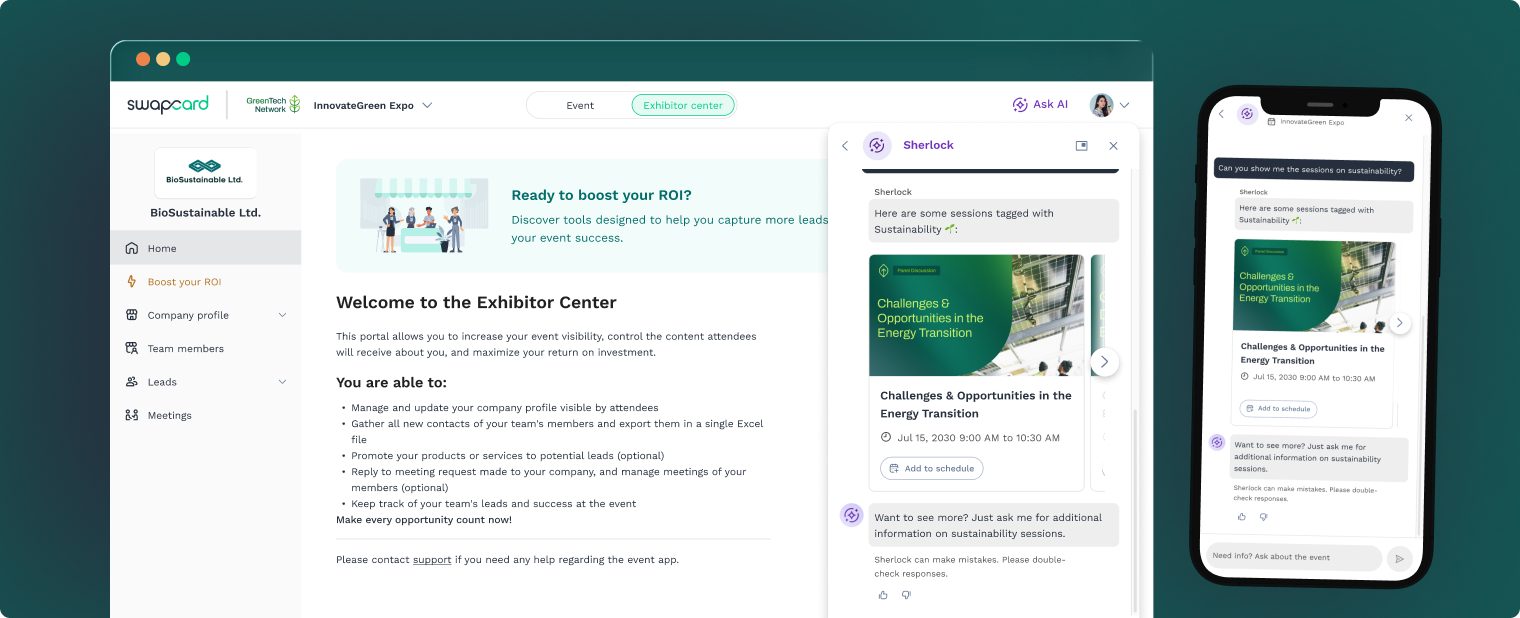
- Sherlock acts as an AI assistant. It can help users find information and get answers within the context of the event rather than relying solely on a generic chatbot.
- Swapcard’s AI recommendation and matchmaking systems help participants discover relevant people, sessions, exhibitors, products, content, and meetings.
- Event AI agents, including Cortex, go a step further by supporting actions and workflows rather than only answering questions or making recommendations.
Together, these tools illustrate three increasingly advanced ways AI can operate inside an event platform: answering, recommending, and acting. Because Swapcard's event AI is connected to event-specific data, it can work with the actual context of the event rather than treating every request as an isolated prompt. For example, at HLTH, a healthcare event with more than 12,000 attendees, Swapcard's event-native AI reached 91% active app usage against a 35% industry average. Exhibitors captured 29,873 leads, an 18% increase year over year, and average exhibitor contacts rose 12%.
These capabilities can also support more effective AI lead generation for events, helping exhibitors identify, prioritize, and engage the most relevant prospects.
How Will AI Transform Events in the Future?
AI is moving from assisting event teams to taking action on their behalf. The shift is going from AI that responds to requests to AI that continuously observes, predicts, and acts within defined rules. Concretely it brings autonomous agents that execute tasks end to end, hyper-personalized attendee journeys built in real time, and predictive planning that forecasts attendance, revenue, and risk before an event opens.
- Agentic AI: Agentic AI describes event AI that can determine what action is needed and carry it out within an event workflow, rather than only answering questions. Swapcard Cortex is the interconnected AI ecosystem built natively into the event platform. It connects generative AI with Swapcard’s event intelligence so AI capabilities can work from shared event context, including participant profiles, permissions, exhibitor information, and matchmaking logic. Sherlock is the participant-facing AI agent, available on web, iOS, and Android. It helps users discover relevant people, sessions, exhibitors, and products, send connection requests, book meetings, and manage saved content. The Architect is the organizer-side AI agent in Swapcard Studio, designed to support tasks such as building registration forms, generating event content, and enriching exhibitor data. These capabilities operate within the relevant visibility and access rules.
- Deeper personalization: In the future, event personalization will move beyond recommendations to combine profile data with real-time behavior, including sessions attended, meetings booked or exhibitors visited. The result is a more dynamic journey in which the agenda, networking suggestions, content, and notifications evolve according to what each participant is actually doing.
- Predictive operations: AI will also make event management more predictive rather than reactive. It means organizers will increasingly use historical and real-time data to identify what is likely to happen next. For example if demand for a session is likely to exceed capacity, organizers can move it to a larger room before queues form. If registrations are tracking below expectations, marketing activity can be adjusted earlier.
How to Choose an AI-Powered Event Platform
Choosing an AI-powered event platform should start with the presence of AI features and evaluate what the AI can actually understand, recommend, and do within an event. A strong platform should :
- Connect AI to real event data
- Provide useful recommendations and assistance
- Operate securely at scale,
- Give organizers control over how automated actions are performed.
AI Connected in Your Event Data
The AI should understand the context of your specific event rather than operate as a generic chatbot. This means being able to work with attendee profiles, registration data, agendas, exhibitors, speakers, meetings, permissions, and engagement activity.
For example, an attendee asking, “What should I attend next?” should receive recommendations based on their interests, role, agenda, and previous activity, not a generic list of popular sessions.
A Real Assistant
A good event AI assistant should do more than answer basic FAQs. It should help attendees, exhibitors, and organizers find relevant information quickly using the event's own context.
A Recommendation Engine Built for Event Matchmaking
For networking events, recommendation quality is one of the most important AI capabilities to evaluate. The platform should be able to compare large numbers of attendee, exhibitor, and content profiles and identify genuinely relevant matches. Events using AI-powered meeting generation report up to 250% more confirmed meetings compared to manual booking, and exhibitors using AI matchmaking generate 2.5x more qualified leads. Across the platform, Swapcard has facilitated 700,000+ meetings.
Recommendations should also remain useful as the event evolves because a platform that continuously updates suggestions based on behavior can create a more relevant experience than one relying only on information collected during registration. Platforms designed natively for trade shows, associations, and B2B conferences tend to deliver this level of matchmaking more consistently than generic tools.
What Are the Challenges of AI in Events?
The main challenges of AI in events are using it without clear objectives, neglecting data privacy, stacking disconnected tools, and removing the human touch. AI adds speed and scale, but it does not replace strategy or hospitality. The organizations that succeed pair AI with clear goals, strong governance, and people where judgment matters.
The four main challenges of AI in events are :
- Using AI without a clear objective : AI amplifies a clear objective, but it cannot create one, so a team that turns it on without defined goals has nothing to measure or steer toward. Organizers should first identify the problem, otherwise, it becomes difficult to measure whether AI is actually improving the event.
- Protecting attendee data and privacy: Event platforms process large amounts of personal and sensitive data, and feeding that data into AI raises a direct question of who can access it and whether it trains external models. Compliance with regulations such as GDPR should therefore be considered from the start, alongside access controls and data governance.
- Using disconnected AI tools: AI becomes less effective when registration, networking, exhibitor data, and analytics are spread across separate systems. One integrated AI layer, working from a single source of event data, produces sharper output than several bolt-on tools stitched together.
- Removing the human touch : AI is effective at processing data, automating repetitive work, and surfacing recommendations, but it cannot replace the judgment, creativity, empathy, and relationship-building that make live events valuable. The strongest approach automates the routine and keeps people on the decisions, relationships, and hospitality that define a live event.
Plan Your Event With Swapcard
Swapcard brings the full event lifecycle into one platform, from registration and attendee engagement to exhibitor management, lead capture, onsite operations, and analytics. By connecting these workflows, organizers can manage their event with a shared source of attendee and exhibitor data instead of relying on disconnected tools.
Sherlock helps participants find relevant information, answer questions, and take supported actions in real time. Cortex connects these capabilities with Swapcard’s AI recommendation and matchmaking systems, while The Architect supports organizer workflows inside Swapcard Studio. Swapcard also combines onsite lead capture with digital engagement signals to help exhibitors identify and qualify opportunities. The result is a more connected event journey, with data flowing from registration through engagement and networking to post-event.
Conclusion: Choose AI That Is Built for Events
AI is becoming most valuable when it is integrated directly into the event experience, not used as a separate tool. For organizers, the main point of AI in events is to use it where it can reduce manual work, improve personalization, and turn event data into more useful actions and decisions.
As AI continues to evolve from assistance to recommendation and execution, platforms built specifically for events will be better positioned to connect these capabilities across the full event lifecycle.
To see event-native AI in practice, explore Swapcard's event AI agents or book a live demo.
FAQ
Will AI Replace Human Event Planners?
No, AI replaces repetitive tasks, not event planners. It can take over repetitive and data-heavy tasks such as drafting content, answering common attendee questions, analyzing feedback, updating information, or producing reports. This gives event teams more time to focus on strategy, creativity, stakeholder relationships, and the onsite experience.
AI also has clear limits. It cannot fully reproduce human judgment, empathy, negotiation, or the ability to understand subtle interpersonal situations. These skills are particularly important in events, where hospitality and personal connections strongly influence the participant experience.
How Can AI Be Used in Event Planning?
AI can support event planning by accelerating research, content creation, forecasting, scheduling, and other time-consuming preparation tasks. Organizers can use it from the earliest planning stages through event delivery and post-event analysis. For example, AI can help teams draft event descriptions and marketing emails, summarize speaker information, prepare surveys, analyze previous event data, estimate attendance, identify registration trends, or suggest agenda structures.
When AI is integrated directly into an event platform, its role can go further, using actual registration and attendee data to personalize recommendations, identify engagement patterns, support capacity planning, and automate workflows based on participant behavior.
What Is the Best AI Event Management Software?
The best AI event management software is the platform whose AI solves meaningful operational or engagement problems. But the right choice depends on the event format, audience, objectives, and the AI capabilities needed.
- A conference focused on content discovery may prioritize personalized agendas and an AI assistant.
- A large trade show may need advanced matchmaking, lead qualification, exhibitor recommendations, and scalable onsite tools.
- Associations may place greater importance on engagement across multiple events and throughout the year.

Jessica Duarte
Product Marketing Manager | Swapcard
Shapes product marketing and go-to-market strategy at Swapcard, drawing on a background in event technology consulting and cross-functional digital marketing leadership.


Join 12,000 subscribers and unlock industry secrets.
By submitting this form, you agree to receive periodic emails on insightful content related to events and our product, and in accordance with our Privacy Policy. You can, of course, change your preferences or unsubscribe at any time.