Event matchmaking checklist: Steps to build better attendee connections
At an IAEE association event, attendees planned 893 meetings before arriving, giving organizers a concrete networking output instead of another activity count. Your association can build that reporting discipline by treating matchmaking as a workflow that starts with registration intent and continues through post-event follow-up. Matching rules and scheduled interaction formats turn member goals into relevant introductions, while meeting records show who connected and what happened next. A practical event matchmaking checklist makes each handoff executable and builds the evidence that renewal conversations require.
Matchmaking is closer to session programming than a cocktail reception. Organizers select the inputs, set relevance rules, reserve agenda time, and measure response. Leaving connections to chance is like publishing an agenda without rooms or times. Disciplined matchmaking strengthens member retention signals and sponsor value. The process works when organizers treat it as an evidence-building workflow, not a social program that happens to run alongside the conference.
Key takeaways:
- Define member, exhibitor, and leadership outcomes before choosing matchmaking metrics
- Collect only the registration data that will affect recommendations or meeting formats
- Use structured attendee profiles for matching, then keep biographies for personal context
- Combine scheduled meetings with attendee-led discovery inside the conference agenda
- Track meeting completion, relevance, and follow-up potential rather than connection volume alone
- Return useful outputs to the association management system (AMS) for future engagement
What your matchmaking program needs to prove
Matchmaking objectives should describe the value a connection is expected to create, not merely the number of connections made. Event-day satisfaction matters, but associations also need signals that support future education, community programming, and member engagement. A measurable objective gives each stakeholder a clear reason to participate.

Separate event-day activity from member value
A connection count shows that two profiles interacted. It does not show whether a first-time attendee found a mentor or an exhibitor reached a relevant buyer. Those outcomes require different matching rules and different reporting.
Association leaders should separate three levels of value:
- Event-day experience: Members found useful people and could arrange meetings without confusion
- Member value: Connections reflected professional goals, expertise gaps, or community interests
- Sponsor value: Exhibitors met attendees with relevant needs and realistic follow-up potential
The second level deserves particular attention. Matchmaking can produce member retention signals, such as repeated participation or continued engagement, without proving that a meeting caused renewal. That distinction protects the credibility of leadership reporting.
Set the reporting output before matching begins
A useful event matchmaking checklist works backward from the post-event report. If leadership expects only a connection total, the program will favor volume. If leadership expects completed meetings by member goal, exhibitor category, and follow-up status, the design must capture better inputs from the start.
One association event organizer described the networking goal directly: "We're bringing the right people in the right ecosystem together and giving them the opportunity to engage digitally." Association leaders comparing those requirements can use a connected event workflow as one reference point while writing the measurement brief. The brief should define what counts as a proposed match, an accepted request, a scheduled meeting, and a completed interaction.
Collect intent at registration
Registration data provides the interests, goals, and expertise needed to create relevant matches. The registration flow is the first engagement touchpoint, not an administrative form that ends once payment clears. Every question should either shape a recommendation, determine access, or support later reporting.
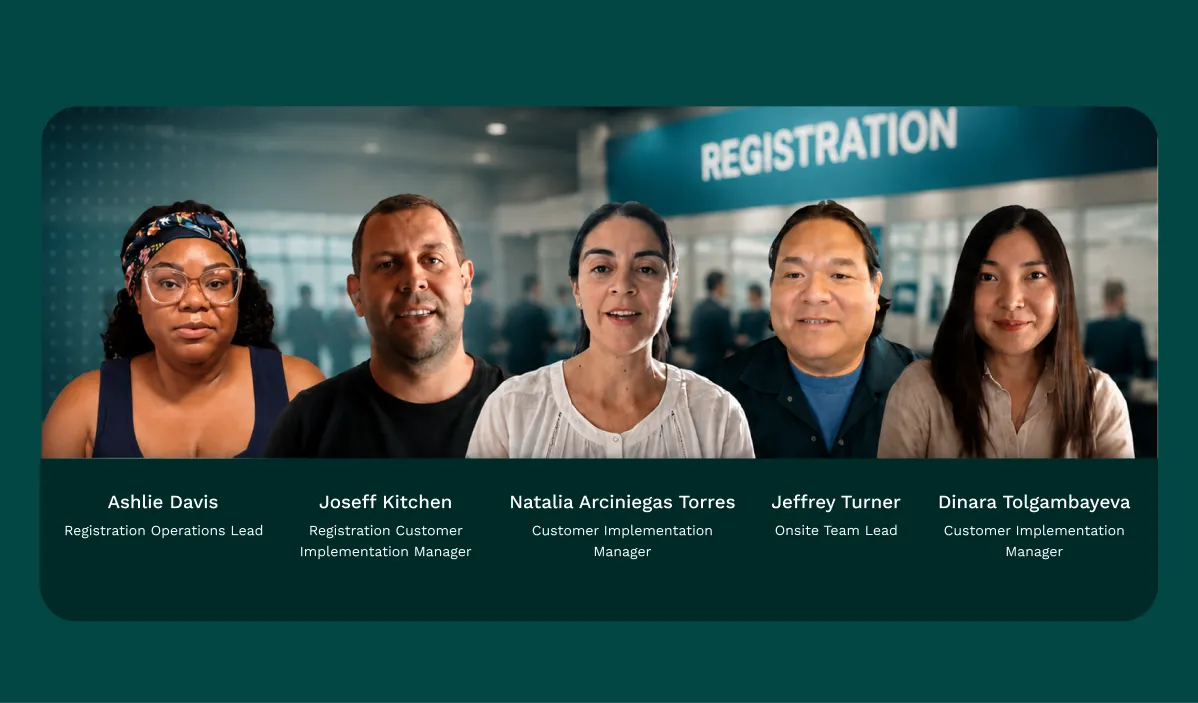
Add a banner promoting the registration myth video
Ask only questions that change a match
Long forms create a real tradeoff. Organizers want enough attendee intent data to improve matchmaking, yet every extra field adds registration completion burden. Collecting more information is not automatically better if event teams never use it.
Before adding a question, organizers can apply four checks:
- Will the answer change who appears in a recommendation?
- Will it affect the meeting format, access rule, or agenda track?
- Can attendees answer it accurately before the conference?
- Will the answer support a defined post-event measure?
If every answer is no, remove the field. A short registration flow with five useful matching inputs has more value than a long form filled with data that remains in an export.
Collect goals as well as interests
Interests identify topics, while goals reveal what someone wants to achieve. Two members may both select workforce development, for example, but one wants a peer benchmark and the other has expertise to share. Shared interests make the topic relevant. Complementary goals and expertise make the conversation useful.
A registration flow might collect:
- Topics the attendee wants to discuss
- Questions or problems they want to address
- Expertise they can offer other members
- Preferred connection types, such as peer, mentor, supplier, or committee contact
- Availability for scheduled meetings
- Permission to appear in searchable profiles
Conditional logic can reduce the burden by showing questions based on attendee type or selected goal. Exhibitors may receive questions about buyer priorities, while members receive prompts about learning or peer exchange. Organizers evaluating association event management software should check how registration inputs connect with profiles, scheduling, and reporting, rather than reviewing the form builder in isolation.
Design structured attendee profiles
Structured attendee profiles turn registration answers into searchable and comparable matching inputs. Flexible biographies still add personality, but they rarely provide consistent data for filtering or recommendations. The profile should make relevance visible before a member accepts a meeting.
Replace biography-only profiles with usable fields
An open biography can reveal useful context, yet wording varies too much for dependable matching. One member may write "membership growth," another may write "chapter development," and a third may describe the same need across several paragraphs. Structured fields place those attendees in comparable categories.
A practical profile design combines fixed choices with one short open response:
- Professional role or function: Used for peer and expertise matching
- Topics of interest: Used for discovery and content relevance
- Current goal: Used to distinguish learning, buying, mentoring, or partnership intent
- Expertise offered: Used to find complementary knowledge
- Organization type or market: Used where sector context affects relevance
- Short biography: Used to explain background in the member's own words
Profiles also need a completeness threshold. If essential fields are blank, recommendations may look arbitrary even when the matching logic is sound. Event teams should identify required matching fields, show members why they matter, and prompt completion before recommendations open.
Match for complement, not just similarity
Shared interests provide a useful starting point, but similarity alone can create repetitive conversations. Pairing two members with the same job title and the same challenge may validate their experience. Pairing a member seeking guidance with another who has solved that problem creates more practical value.
Organizers should test each rule against the intended outcome. If the goal is peer exchange, shared role and topic may carry more weight. If the goal is mentoring, complementary experience matters more. For exhibitor meetings, attendee need, buying role, and follow-up potential should matter more than broad industry overlap.
Interest-based matching also works better when organizers explain each recommendation. A short reason such as "Both members selected chapter growth, and one has experience launching regional programs" makes the logic visible. That explanation supports trust, while practical meeting details turn relevance into action.
Embed matchmaking into the agenda
Matchmaking should sit inside the conference agenda with searchable profiles, scheduling, and messaging. Members need a clear path from discovering a relevant person to arranging an interaction. If any part sits in a separate tool or spreadsheet, participation requires extra work.
Reserve time for scheduled and attendee-led meetings
Scheduled meetings give matchmaking a dependable place in the program. Without reserved time, accepted requests compete with sessions, meals, exhibitor visits, and committee responsibilities. The meeting may look successful in the platform while never happening onsite.
Attendee-led discovery still matters. Some members prefer to browse profiles, send a message, and decide whether to meet. Others value organizer-curated appointments because they have limited time or do not know the community well. The agenda should support both behaviors:
- Open profiles and recommendations before the conference
- Let members save profiles or send meeting requests
- Reserve meeting blocks outside essential sessions
- Show the meeting place, duration, and participant details
- Send reminders and allow messaging before the scheduled time
- Record whether the meeting took place
Interest-based recommendations need context and logistics at the same moment. A relevant name without a reason feels random. A reason without an available time remains an idea.

Promote the program before members arrive
Members will not engage with a tool they learned about at check-in. They need time to complete profiles, review recommendations, accept requests, and place meetings around their sessions before the opening reception begins.
One association event organizer captured the benefit of giving members usable networking tools: "It gives them the opportunity to take advantage of everything the event has to offer." Another described the return on that investment directly: providing attendees with the right product or service to support their goals is always worth the effort.
Promotion should explain the member outcome, not just announce a feature. A message such as "Complete three profile fields to receive relevant peer recommendations" gives members a reason to act. The event app engagement checklist can extend that activation plan across launch messages, profile prompts, and pre-event reminders.
The decision point is practical: can a member move from recommendation to confirmed agenda slot within one platform workflow?
Measure meetings and exhibitor leads
Meeting measurement should show who met whom, why the match was relevant, and whether follow-up has potential. Connection totals and badge scans capture volume, but they do not explain value. Associations need a small set of measures that support member, exhibitor, and leadership reporting.
Track the meeting journey, not one action
Tracking who met whom creates a measurable output for post-event reporting. The record becomes more useful when organizers capture stages instead of treating every request as a completed connection. A sent request, accepted request, scheduled meeting, and completed meeting describe four different levels of participation.
A practical measurement set includes:
- Profile completion rate
- Recommendations viewed
- Meeting requests sent and accepted
- Meeting acceptance rate
- Scheduled and completed meetings
- Cancellations or unanswered requests
- Meetings by member goal or interest
- Repeat engagement after the conference
Acceptance rate is particularly useful because it tests recommendation relevance. A high volume of ignored requests may indicate weak profiles, unclear reasons, or poor timing. Organizers can use event engagement metrics to place meeting activity within a wider view of activation and participation.
Grade exhibitor relevance and follow-up potential
Exhibitor lead volume does not reveal exhibitor lead quality. A badge scan may represent a useful sales conversation, a prize draw, or a person collecting literature. Associations need to separate contact capture from evidence that the attendee had a relevant interest.
Exhibitor reporting can add context through:
- Attendee goal or area of interest
- Meeting request and acceptance status
- Meeting completion
- Lead qualification response
- Exhibitor staff notes
- Agreed follow-up action
- Permission for continued contact
IAEE Expo! Expo! provides a documented example of turning structured networking into exhibitor value. The program recorded 893 meetings planned in advance, while 60% of leads received a top quality score of five out of five. Those figures show what the organizers measured; they do not prove that matchmaking alone caused future renewals.
A genuine limitation remains. Detailed qualification asks exhibitors to train staff and use the agreed process onsite. That takes more preparation than distributing a lead retrieval login, but it produces a record that commercial teams can interpret after the hall closes. One customer reflected on the partnership value: "Definitely glad of the partnership and looking forward to more years of that." That sentiment points to sustained program confidence, not a single metric.
Return outputs to the AMS
Useful matchmaking outputs should return to the association management system as member engagement records, not disappear into a post-event spreadsheet. The AMS remains the membership record, while the event platform captures conference behavior. Connecting the two supports leadership reporting and more relevant year-round engagement.
Define outputs without inventing field mappings
Association leaders should specify which event outputs belong in the AMS before discussing vendor-specific mappings. Exact field structures vary, and an article cannot prescribe them responsibly. The useful planning decision is to define the business meaning of each output.
The return plan may include:
- Matchmaking participation status
- Topics and professional goals
- Meetings requested, accepted, and completed
- Member or exhibitor connection type
- Follow-up preference
- Committee, education, or community interest
- Date and source event
Not every click belongs in the AMS. Saving every profile view creates noise and makes member records harder to interpret. Return the signals that can inform a real decision, such as inviting a member to a working group, recommending related education, or identifying an exhibitor conversation that needs follow-up.
Connect the workflow without replacing the AMS
Swapcard supports this matchmaking workflow by keeping intent data, profile behavior, and meeting activity connected across one platform. Registration captures declared goals, AI Matchmaking surfaces relevant connections as attendees engage, and Smart Meetings creates the scheduled touchpoints that produce measurable records. Lead qualification through the Exhibitor Lead Center gives exhibitors the data they need for follow-up. The 365 Event Hub extends profiles and discovery between conferences, connecting event activity to broader association membership goals rather than letting the networking program end at closing remarks.
The platform does not replace the AMS, and sparse profiles can still weaken recommendation quality. Organizers must define the data they collect, the matching rules they approve, and the records they want to retain.
An exhibitor-focused association organizer described the commercial purpose directly: "Using Swapcard for our exhibitors is really important to maximize their return on investment." Association leaders ready to connect intent, meetings, and reporting can build the workflow with Swapcard while keeping AMS ownership and field design within their association's data policy.
Defensible member and sponsor value is the goal. The complete workflow to get there is clear: collect useful intent during registration, build structured attendee profiles, match shared interests with complementary goals, promote meetings before the conference, measure completed interactions, and return meaningful outputs to the AMS.
FAQs
How do I set up attendee profiles for better matchmaking? To create effective attendee profiles for matchmaking, start by gathering key information during registration. Ask about their professional role, topics of interest, and current goals. Use Swapcard's registration system to collect this data efficiently. Make sure to include structured fields instead of open biographies to ensure consistency and comparability. This structured approach helps in generating relevant matches based on shared interests and complementary goals.
What if my attendees are not using the matchmaking features? If attendees aren't engaging with matchmaking, consider promoting the features before the event. Use Swapcard's push notifications to remind them about the benefits of connecting with others. Additionally, provide clear instructions on how to use the matchmaking tools, and encourage them to complete their profiles. Engaging content and reminders can help increase usage and participation in the matchmaking process.
When should I collect registration data for matchmaking? Collect registration data as early as possible, ideally during the initial sign-up process. This allows you to tailor matchmaking recommendations based on attendee intent from the start. Use Swapcard's registration capabilities to streamline this process and ensure you gather only the most relevant information that will impact matchmaking. The sooner you have this data, the better you can facilitate meaningful connections.
Can I track the effectiveness of my matchmaking efforts? Yes, you can track the effectiveness of your matchmaking efforts by measuring key metrics such as the number of scheduled meetings and the completion rate of those meetings. Use Swapcard's reporting features to analyze this data and gain insights into attendee engagement. By focusing on the quality of connections rather than just quantity, you'll be able to assess the real impact of your matchmaking initiatives.
Why does my event need structured attendee profiles? Structured attendee profiles are crucial because they provide consistent and comparable data for matchmaking. By using fixed fields for roles, interests, and goals, you can ensure that the matchmaking process is more effective. Swapcard's platform allows you to create these structured profiles, which helps in generating relevant matches that lead to meaningful connections, enhancing the overall event experience.

Bhavya Sharma
Senior Content Marketing Manager
Bhavya leads content strategy across the funnel at Swapcard, pairing flagship research with storytelling that turns awareness into pipeline.


Related articles

Join 12,000 subscribers and unlock industry secrets.
By submitting this form, you agree to receive periodic emails on insightful content related to events and our product, and in accordance with our Privacy Policy. You can, of course, change your preferences or unsubscribe at any time.