Exhibitor operations and monetization: Why B2B organizers need an event matchmaking strategy

Connection counts do not belong on an exhibitor invoice. For a Sponsorship and Exhibits Director, an event matchmaking strategy earns commercial value only when it delivers qualified buyer meetings and credible return on investment (ROI) reporting.
Matchmaking, therefore, needs the same discipline as any other sponsorship product. Organizers must define what exhibitors buy, how buyers qualify, what counts as delivery, and which evidence reaches budget holders before renewal decisions.
Key takeaways:
- Package qualified meetings as defined exhibitor deliverables, not access to a general networking directory
- Combine profile criteria with behavioral intent to protect meeting quality
- Treat pre-event engagement as part of the paid exhibitor outcome
- Measure meetings booked, confirmed, and completed separately
- Deliver lead quality and meeting reports before exhibitor budgets are fixed
Generic networking weakens pricing power
Generic networking weakens pricing power because access alone does not give exhibitors a measurable commercial outcome. A directory, chat function, or connection count supports the attendee experience, but none proves that a sponsor met qualified buyers. Premium pricing requires a clearer promise, and that promise is the foundation of any defensible event matchmaking strategy.
Connections are not deliverables
Connections measure activity. Deliverables measure what the organizer agreed to provide. One hundred connection requests can produce a few accepted conversations, while a smaller set of confirmed meetings gives an exhibitor a credible route to pipeline.
A general networking directory is similar to expo hall admission. Both provide useful access to the wider audience, but neither reserves time with a relevant buyer. Organizers cannot price open access like protected meeting inventory without buyer qualification and delivery rules.
Before adding matchmaking to a premium package, event teams can test the offer with four questions:
- Does the package define the buyer criteria
- Does it commit to a specific number or range of meetings
- Does it distinguish between booked, confirmed, and completed meetings
- Does the report show lead quality after each meeting
If any answer is no, the package still sells access rather than an outcome.
Budget holders demand commercial proof
An Exhibitor Marketing Lead rarely takes app opens into a budget review. They take meeting completion, qualified contacts, and evidence that the event reached the accounts or roles they wanted.
General networking still has value for members, and associations have good reasons to make it widely available. That value to the member does not automatically make it premium sponsorship inventory. The commercial layer begins where the organizer commits to qualified access and reports delivery against that commitment. Miss that distinction, and every renewal conversation becomes an argument about price rather than proof.
Qualified meetings become sellable inventory
Qualified meetings become sellable inventory when organizers define buyer criteria, access terms, and delivery metrics in the package itself. Clear commitments turn matchmaking from a broad engagement feature into a revenue product that supports sponsorship package pricing.
Exhibitors buy meeting commitments
Exhibitors buy confidence that relevant conversations will happen. They do not pay a premium simply because a meeting scheduler appears in the event app. A stronger package sets a meeting commitment and describes the audience behind it.
The package description should name the commercial outcome in plain language. Organizers can promise access to vetted buyers who match the stated role, authority, need, or purchasing criteria, and then define how many meeting opportunities are part of the package. Organizers building this level of qualification and reporting can review Swapcard's Hosted Buyer capabilities before rewriting the prospectus.
Confirmed access supports a premium
Exhibitors pay more for hosted buyer slots when they can review buyer profiles and receive confirmed meetings. Profile access lets exhibitors prepare account questions before the association's annual meeting, while confirmation protects calendar time that would otherwise depend on chance booth traffic.
The package promise must appear before the sale. If buyer visibility, meeting volume, or confirmation rules remain unclear until onboarding, the commercial team has sold an expectation that operations may not be able to deliver. A credible event matchmaking strategy sets those terms in the prospectus and the exhibitor agreement.
Commercial teams can also place qualified meeting packages beside other event monetization tools. A banner sells visibility, while a meeting package sells structured access to qualified demand. Positioning the offer within the broader inventory makes that distinction clear.
Delivery terms define the product
Delivery terms separate the offer from general networking. Booked means a time was selected. Confirmed means both parties accepted. Completed means the meeting took place. Combining those stages into one number hides no-shows and weakens the renewal report.
Ownership matters as much as terminology. Event teams should assign one owner for buyer approval, one for schedule delivery, and one for reporting. In smaller programs, one person can hold all three responsibilities, but the roles still need to be explicit.
A package is ready to sell when sales and operations give the same answer to the same question: what exactly has the exhibitor bought?
Buyer qualification protects meeting quality
Buyer qualification protects meeting quality by combining declared profile fit with observed intent. Static profiles show who a participant is, while pre-event actions show what they are exploring. Using both signals reduces the number of irrelevant meetings as participation grows.
Profiles establish buyer fit
Start with the promise made to exhibitors. If the package offers access to procurement leaders, a general management title is not enough. If it promises buyers planning a purchase, the role alone does not establish readiness. Association organizers can screen by job role, purchasing authority, stated needs, or company type, and each criterion must be directly linked to the package claim.
A useful diagnostic compares every buyer field with a decision. If removing a field would not change eligibility, matching, or reporting, the field does not strengthen the program. Cut it, and the qualification form stays sharp.
Behavior validates stated intent
A participant can select an interest during registration and never act on it again. Searches, exhibitor profile views, saved products, session choices, and meeting requests provide a second layer by indicating active attention.
Behavior does not replace the profile. A frequent profile visitor may be a student, consultant, or early-stage researcher rather than a current buyer. Organizers protect lead quality scoring by using behavior to validate fit rather than to override basic eligibility.
Event teams can apply a simple conditional rule. If profile fit is strong and behavior supports the same need, prioritize the match. If the behavior conflicts with the stated interest, hold the participant for review instead of filling the calendar for volume.
Rules preserve quality at scale
More meeting requests do not always create more value. Without request caps, eligibility gates, and profile-completeness requirements, active participants can crowd out buyers who have fewer open slots but a stronger commercial fit.
Scale also increases operational pressure. A program with limited buyer supply cannot sell unlimited sponsor access without damaging the participant experience. Event teams should compare the number of approved buyers, realistic meeting capacity, and sold commitments before releasing additional inventory.
If committed meeting demand approaches available qualified supply, stop selling packages or reduce the commitment. Protecting quality is more valuable than recording a larger booking total that later produces weak completion.
Pre-event demand creates lead value
Pre-event demand creates lead value because buyers research suppliers and reserve meetings before arriving onsite. Early activation therefore belongs inside the paid exhibitor outcome, not beside it as a general app adoption campaign. The commercial window starts before the venue opens.
Early activation captures buyer demand
The State of Event Engagement Report Volume 2 found that 60–65% of networking and 40% of exhibitor leads occur before the event. An onsite-only meeting strategy ignores a large share of observable buyer intent.
Pre-event engagement gives exhibitors time to review profiles, prepare outreach, and reserve qualified buyer meetings. It also gives organizers time to spot weak categories before arrival. If one exhibitor segment receives few profile views or meeting requests, the event team can adjust communication while schedules remain open.
Early activation requires added work. Profiles need to be complete, exhibitors need onboarding, and buyer communications must start before onsite duties take over. The commercial value justifies that work when early actions feed the package report.
Advance bookings create lead value
Expo! Expo! shows why advance activity belongs in the commercial scorecard. Organizers planned 893 meetings before the event, and 60% of leads received the highest quality score, according to IAEE's Expo! Expo! matchmaking results.
Advance bookings provide more than calendar volume. They show that a participant reviewed the opportunity, accepted the conversation, and reserved time. That sequence provides exhibitors with stronger evidence of intent than an unqualified badge scan.
The operational requirement is straightforward: preserve the link between the buyer signal and the meeting outcome, so the same intent that produced the booking still appears in the exhibitor report.
Completed meetings prove commercial value
Completed meetings prove commercial value because they show that the organizer delivered the promised buyer access. Booking volume remains useful for forecasting, but completion and lead quality provide stronger proof for exhibitor pricing, budget reviews, and renewal decisions.
Completion outweighs booking volume
A full calendar can look convincing two days before an association conference. Empty chairs tell a different story onsite. Reporting only the booked total leaves exhibitors to absorb cancellations and no-shows without a clear view of delivery.
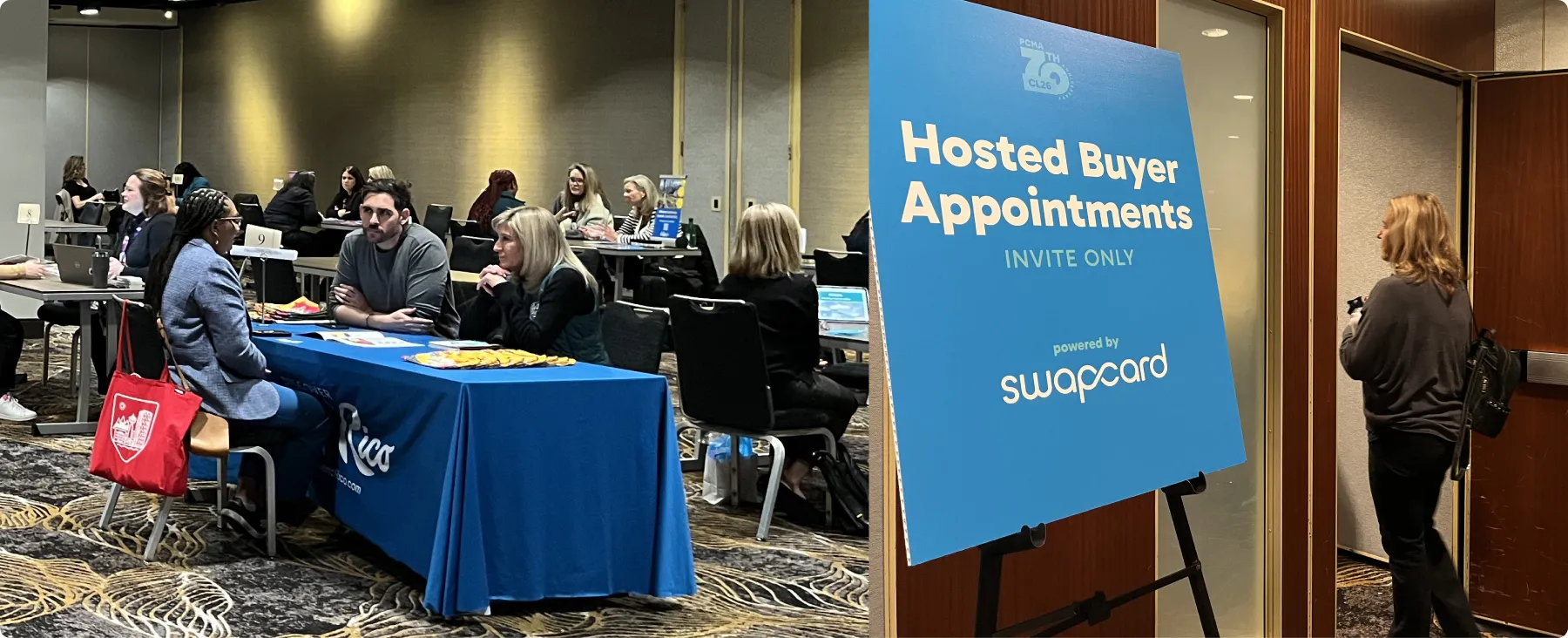
PCMA completed all 244 hosted buyer meetings and recorded a 4.5 customer satisfaction (CSAT) score. Those measures work together. Completion proves that the meetings happened, while satisfaction indicates whether participants considered the experience valuable.
Organizers should report the conversion from booked to confirmed, then from confirmed to completed. If completion drops, the event team can inspect reminders, schedule density, meeting length, and onsite support before changing the matching criteria.
Lead quality defends package pricing
Lead quality explains whether the completed meetings reached the intended commercial audience. A top-quality lead rate gives the Sponsorship and Exhibits Director stronger renewal evidence than total connections because it ties delivery to the exhibitor's objective.
Set lead quality criteria before the program opens. Exhibitors can score factors such as buying role, stated need, and timing. Changing the definition after results arrive makes year-over-year comparisons unreliable.
A credible report pairs the completion rate with the lead quality distribution. High completion with low quality points indicates weak qualification. High quality with low completion points to schedule or communication gaps. Each pattern requires a different operational response.
Digital signals require follow-through
Digital touchpoints account for 67–85% of event leads, yet only 3% of exhibitors download their leads within 90 days, according to the State of Event Engagement Report Volume 2. Collecting intent without delivering it into the exhibitor workflow wastes much of the value created.
A customer relationship management (CRM) system remains the place where exhibitor sales teams manage pipeline. The event platform must provide qualified, usable records that can reach that system with context attached. Meeting status, lead score, and notes give the sales team a reason to act.
Lead delivery also needs a named owner. If exhibitors receive a login and no follow-up, even a strong dataset can sit unused. Organizers should schedule the report handoff, confirm access, and identify who owns follow-up before the event closes.
Association governance protects both sides
Association governance protects both member access and sponsor value by separating open networking from limited qualified-meeting inventory. Transparent eligibility rules preserve the association's mission, while controlled supply gives exhibitors a commercial product worth buying.
Member access remains mission-aligned
Member networking is central to many association events, and not every valuable conversation should sit behind a sponsor package. Open directories, peer meetings, and informal networking can remain available across the membership.
The paid layer should offer structure rather than unfair access. Qualification criteria, meeting availability, and participation rules need to be applied consistently. Members should understand why they qualify for a hosted buyer program and what participation requires.
Sponsor value needs a protected supply
Qualified buyer time is limited. Selling too many meeting packages places pressure on buyers and lowers the value of every slot. Associations, therefore, need supply controls that protect the buyer experience before sponsor demand is accepted.
Reserve capacity for participant choice. When every open period becomes a sponsor meeting, the program starts serving the package rather than the member. Protected calendar space preserves trust and often improves completion because buyers are not overbooked.
Premium value must cover delivery
Premium meeting packages carry real costs. Buyer recruitment, scheduling, and reporting all require capacity. Associations should calculate those costs before setting a package price.
Compare expected package revenue with the direct delivery cost and the realistic supply of qualified meetings. A smaller program with consistent completion and credible reporting creates more renewal value than a larger program built around unsupported volume.
Timely reporting secures renewals
Timely reporting secures renewals by giving exhibitors evidence before budget decisions are made. The report should connect the package purchased to pre-event activity, meeting delivery, lead quality, and sales-ready outcomes. A retrospective summary sent months later arrives after the commercial decision.
Reports arrive before budget decisions
Set the reporting date when the package is sold. Sponsorship teams know when major exhibitors begin annual planning, so the ROI reporting schedule should work backward from those dates rather than from the event team's internal review calendar.
When registration, meeting, and lead data sit in a single reporting layer, organizers can directly compare meetings booked with completed meetings without rebuilding the story from separate spreadsheets. An exhibitor management portal gives organizer and exhibitor teams a shared place to manage that delivery.
Commercial KPIs tell one story
Commercial reporting works when every metric answers part of the same question: did the exhibitor receive qualified access and usable follow-up value?
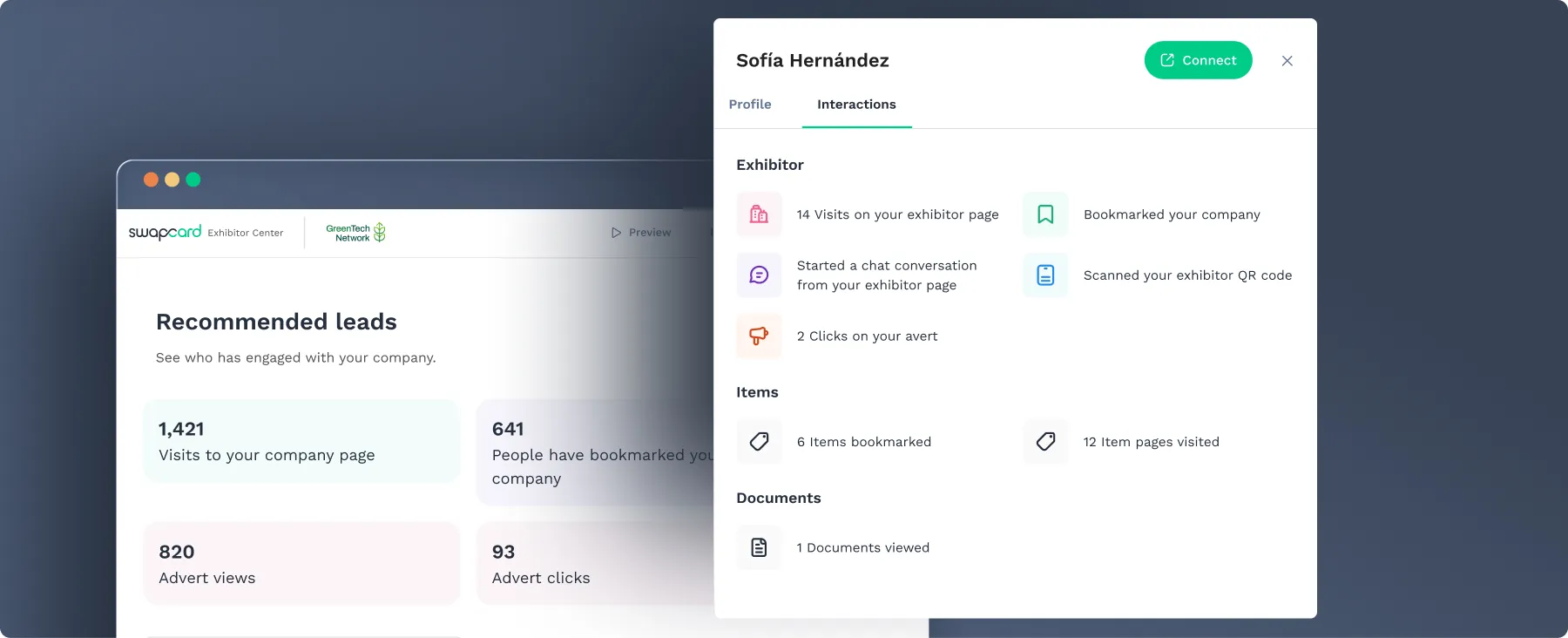
AI-driven matchmaking uses profile data and participant behavior to improve suggestion relevance before and during the event. The Exhibitor Lead Center then brings meeting and lead records into one exhibitor-side inbox, where leads can carry notes and qualification scores.
The renewal scorecard should include:
- Meetings booked
- Meetings confirmed
- Meetings completed
- Completion rate
- Top-quality lead rate
- Pre-event leads and meeting activity
- Leads delivered for CRM follow-up
Draft the package from proof
Build the next package from the evidence the association can reliably deliver. Before sales begin, confirm three things: which buyer criteria determine eligibility, what meeting commitment the organizer is making, and what report exhibitors will receive before their next budget decision.
Then write the prospectus in commercial language. State who qualifies, what exhibitors receive, how meeting delivery is counted, and which outcomes appear in the renewal report. Avoid promises that operations cannot support.
Association teams planning a premium meeting product can get started with Swapcard by mapping buyer qualification, meeting delivery, lead capture, and reporting in one workflow.
FAQs
How do I implement a successful Hosted Buyer program?
To implement a successful Hosted Buyer program, start by clearly defining your buyer criteria and ensure you have a structured process for vetting participants. Next, utilize Swapcard's platform to automate matchmaking based on buyer profiles, exhibitor capabilities, and stated interests. This will help you efficiently pair buyers with relevant exhibitors. Additionally, set rules for meeting requests, such as caps on daily requests and minimum profile completeness requirements, to maintain quality. Finally, ensure you track and report on meetings booked and leads generated to provide clear evidence of ROI for your exhibitors.
What if my exhibitors are not seeing the value in their participation?
If your exhibitors are not seeing value, first gather data on their engagement levels, such as booth visits and session attendance. Use this information to have a conversation with them about their goals and expectations. You can also enhance their experience by providing detailed reports on their item-level engagement, including views and interactions. This transparency can help them understand the value they are getting and encourage them to renew their participation for future events. Consider implementing a structured follow-up process to ensure they capitalize on leads generated during the event.
How do I ensure high-quality meetings during my event?
To ensure high-quality meetings, start by activating your event platform at least six weeks before the event. This allows attendees and exhibitors to pre-book meetings, which can lead to warmer leads and more productive conversations. Additionally, implement Smart Meetings rules that set caps on meeting requests and require profile completeness to protect the quality of matches. Lastly, provide ongoing support and resources to both attendees and exhibitors to facilitate meaningful connections and follow-up after the event.
When should I start promoting my event to maximize attendance?
You should start promoting your event at least six weeks in advance. This early activation not only helps in driving registrations but also allows attendees to familiarize themselves with the platform and plan their schedules. By releasing pre-event content and enabling features like pre-booked meetings, you can significantly enhance engagement and ensure that attendees arrive with a clear plan. This proactive approach will help you maximize attendance and participation during the event.
Can I use digital engagement data to justify sponsorship fees?
Yes, digital engagement data is crucial for justifying sponsorship fees. By tracking metrics such as session attendance, lead scans, and audience demographics, you can provide sponsors with concrete evidence of their ROI. Make sure to share this data post-event, highlighting how their sponsorship contributed to engagement and connections. This approach not only helps in retaining sponsors but also allows you to build stronger, more tailored sponsorship packages for future events.

Bhavya Sharma
Senior Content Marketing Manager
Bhavya leads content strategy across the funnel at Swapcard, pairing flagship research with storytelling that turns awareness into pipeline.


Join 12,000 subscribers and unlock industry secrets.
By submitting this form, you agree to receive periodic emails on insightful content related to events and our product, and in accordance with our Privacy Policy. You can, of course, change your preferences or unsubscribe at any time.