
Your event team closed the annual conference last week, yet sponsor reports still require manually matching registration records to lead files. Adding another coordinator may clear the backlog, but it leaves the broken handoffs in place for every chapter meeting that follows.
License fees are visible. The higher cost sits in the handoffs between an association management system (AMS), registration, attendee engagement, lead capture, and customer relationship management (CRM). Map those handoffs correctly, and event leaders can see where consolidation will reduce work and restore portfolio-level return on investment (ROI) proof.
Key takeaways:
- Count reconciliation hours, integration upkeep, reporting lag, and evidence gaps alongside license fees
- Use shared definitions for registrations, active attendees, meetings, and qualified leads
- Join attendee identity across the AMS, registration, engagement, lead capture, and CRM
- Keep specialist tools only when governed integrations preserve attribution
- Migrate the highest-cost handoffs first and measure reporting time, data completeness, and follow-up speed
Why does your event team keep doing the same work after every conference
The invoice only shows the software. Ask any coordinator what the week after a conference looks like, and the real cost becomes visible: hours matching records, chasing lead files, and rebuilding reports that should already exist. Fragmented stacks repeat the same disconnected work at every new event, and the labor between the systems never appears on any invoice.
Model the full stack cost
License spend gives event leaders only the first line of the total cost of ownership. A useful cost model also counts the staff time required to move data, correct duplicate records, maintain integrations, rebuild reports, and chase missing lead files. Those hours often span events, membership, finance, and IT budgets, which makes the actual total difficult to see.
Start with four auditable cost lines for each annual meeting, educational symposium, and chapter event:
- Reconciliation hours spent matching records and correcting fields
- Integration upkeep required to monitor mappings, errors, and vendor changes
- Reporting lag between an event interaction and a usable portfolio report
- Evidence gaps where sponsor activity cannot be linked to meetings, leads, or follow-up
The model does not need an industry-wide dollar benchmark. Multiply internal hours by the association's loaded labor cost, then add vendor and integration spend. Event platform pricing and hidden costs deserve the same line-item scrutiny as license fees, because the reconciliation and maintenance overhead is where most associations find the gap.
Count every repeated handoff
One manual export looks manageable. The same export across 12 events, three chapters, and several attendee types becomes an operating model. At 12 events per year, a two-hour reconciliation per event represents 24 staff hours before labor cost is applied — and that is a single handoff in a multi-system stack.
Treat each handoff like an onsite badge checkpoint. If the attendee appears under a different identifier at every door, staff cannot prove that the person who registered also attended a sponsored session, booked a meeting, and became an exhibitor lead. More staff can manage the checkpoint, but they cannot repair the identity chain. That is the real cost of tool sprawl.
Associations should count a handoff whenever data changes system, owner, format, or definition. Include scheduled and manual exports. Automation does not eliminate costs when staff still monitor errors and reconcile exceptions.
Fragmentation breaks portfolio ROI
Tool sprawl becomes a commercial problem when inconsistent records prevent event leaders from comparing performance and proving sponsor value across the portfolio.
Set common portfolio metrics
Registrations are not comparable across events if one chapter counts completed payments while another counts abandoned forms. The same problem applies to active attendees, meetings, leads, and sponsor impressions. Cross-event analytics need a shared definition before they need another dashboard.
Set the portfolio definition, calculation method, system of record, and reporting deadline for each required metric. Chapters can retain event-specific fields, but they should not redefine the measures used for board reporting. If local teams cannot reproduce a metric from the documented rule, exclude it from portfolio comparisons until the definition is fixed.
Standardization does require judgment. A medical conference may need continuing education attendance, while a trade exhibition may focus on buyer meetings. Those local measures can remain, provided the required portfolio measures stay consistent across formats.
Connect activity to outcomes
Registration totals and app logins describe reach, not ROI. Credible sponsor attribution connects registration intent to session engagement, meeting activity, lead capture, qualification, and CRM follow-up. Without that chain, a sponsor receives activity counts that cannot support a renewal decision.
Use one attendee journey as the diagnostic. Select a registered member who viewed a sponsored session, saved an exhibitor, booked a meeting, and entered the exhibitor's lead process. If event teams cannot follow that record across systems without manual matching, the event tech stack does not support reliable attribution.
A unified record also changes commercial planning. Sponsorship teams can compare which packages generated meetings or qualified leads across multiple association events, while event leaders can connect those outcomes to event revenue growth. Evidence becomes useful before the next rate card is approved.
Renewal evidence arrives too late
Only 3% of exhibitors download their lead reports within 90 days, according to first-party findings in the State of Event Engagement Report Volume 2. That delay leaves organizers without timely renewal evidence and exhibitors without a clear path from onsite conversations to sales follow-up.
The low download rate is not only an exhibitor behavior problem. It also exposes a delivery gap. If lead retrieval requires a separate login, manual export, or delayed file, the event tech stack places the final step of ROI proof on the stakeholder with the least reason to manage another system.

Set a delivery baseline before consolidation. Measure the time from lead capture to CRM availability, the share of exhibitors receiving usable reports, and the number of records with qualification context. Late evidence weakens exhibitor renewals even when the event itself performed well.
Joined records restore attribution
Credible portfolio reporting requires joined attendee and company records, shared workflow ownership, and governed integrations for every specialist system that remains.
Match identity across core systems
Start the consolidation audit with identity, not features. An association member may appear under a member ID in the AMS, an email address in registration, a profile ID in the event app, and a contact ID in the CRM. Without a durable matching rule, data reconciliation becomes unavoidable.
Test five records across the full journey. Include a member, non-member, speaker, exhibitor representative, and hosted buyer. For each person, verify whether the same identity connects registration, session activity, meetings, lead capture, and follow-up.
AMS integration deserves particular scrutiny because member status affects pricing, access, and reporting. If a status change creates duplicate profiles or fails to update downstream access, the association ends up with several partial versions of the same attendee instead of one source of truth.
Unify the core data layer
The core test of successful consolidation is whether shared data and workflows remain joined from registration through sponsor reporting. Procurement can remove two contracts and still leave event teams rebuilding the same reports.
Place registration, engagement, meetings, and lead outcomes in the unified core when several teams rely on the same records. Keep a specialist system when it adds distinct value that the core does not provide, such as a complex peer-review process or a specialized venue workflow. The integration must preserve identity and attribution. For example, if a session attendance record arrives 48 hours after the event without the attendee's member ID, the meeting activity for that person cannot be attributed in the sponsor report.
Full replacement is not always the right answer. Specialist systems often contain years of configuration and staff knowledge, and removing them can create more risk than value. Consolidation should remove destructive handoffs, not useful expertise.
Govern every specialist integration
Governed integrations need named owners and explicit rules. Document which system creates a record, which can update it, and what happens when a transfer stops. An integration without operational ownership becomes another hidden dependency.
Use four questions before retaining any specialist tool:
- Does it add a capability that the unified core cannot support
- Does it preserve the portfolio identity key
- Does data arrive within the required reporting and follow-up window
- Can event teams detect and correct an integration gap before reporting closes
A retained specialist tool that cannot answer all four questions needs a migration plan before the next event cycle begins.
Standardization preserves local flexibility
Associations can create comparable reporting without forcing every chapter, annual meeting, or educational program into an identical configuration.
Standardize templates and ownership
Shared templates reduce repeated setup while protecting the data definitions required for portfolio reporting. Each template should define required registration fields, sponsor data, and report outputs. Local teams then start with an approved structure rather than rebuilding the event tech stack for each program.
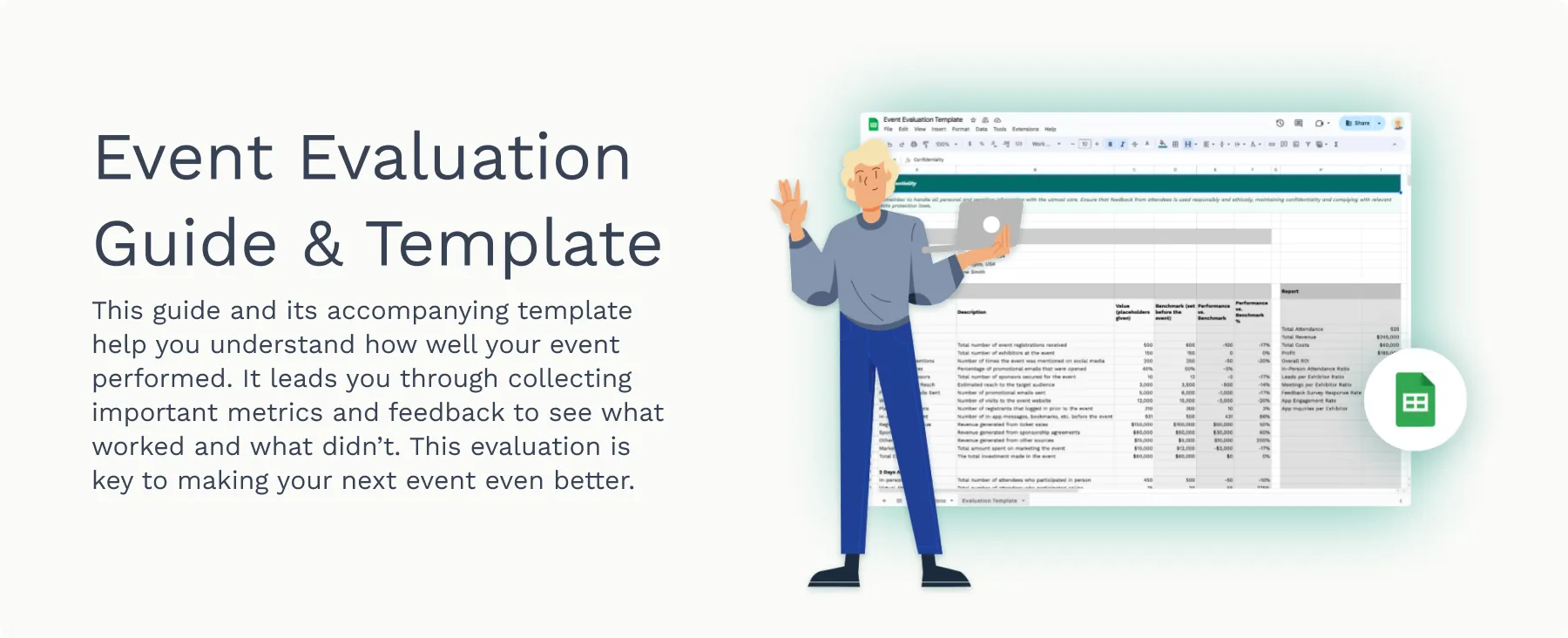
Ownership matters just as much as the template. Assign one portfolio owner for definitions and one local owner for execution. The portfolio owner controls required fields and calculation rules, while the local owner manages agenda details, chapter content, and event-specific communications.
Templates should also include validation points. Check identity matching before registration opens, field mappings before exhibitor onboarding, and report completeness before renewal conversations begin. Catching a gap before launch costs less than reconstructing intent afterward.
Preserve chapter-level flexibility
Chapter autonomy works when local choices do not break shared reporting. A regional meeting can add topic preferences, dietary questions, or local sponsor fields while still using the portfolio definitions for registration, attendance, meetings, and leads.
Separate required fields from configurable fields inside each template. Required fields feed cross-event analytics. Configurable fields support local programming and audience needs but do not alter the core calculations.
Some associations will resist this split because local events have operated independently for years. That concern is valid. The sharper point is that autonomy should shape the attendee experience, not create conflicting definitions for the board and sponsors.
Control exceptions without losing comparability
Exceptions need an owner, reason, scope, and expiry date. Without those controls, a temporary chapter request becomes a permanent field variation that weakens the next portfolio report.
Create an exception process with three decisions:
- Approve when the local need does not alter the required metrics
- Redesign when the need changes a shared field or identity rule
- Reject when the exception removes a required attribution point
Review exceptions after each event cycle. Repeated requests may signal that the standard template needs revision. One-off preferences should expire rather than spread across the event portfolio.
Consolidation delivers measurable portfolio gains
First-party customer evidence shows that joined data can reduce manual reconciliation while supporting more consistent measurement across a large event portfolio.
Informa removes manual reconciliation
First-party evidence from the Informa Tech data consolidation case shows the operational value of joining records across business units. Integrating that data saved Informa Tech two weeks of manual work per event while giving the team a fuller view of the attendee journey.
Patrick Shields, Director of Customer Success at Informa Tech, described the change directly: "Swapcard helped us with the integration of data across our different business units ... and helped my team save two weeks of work per event." That saving represents work removed from the process, not another person hired to maintain it.
The Informa partnership also demonstrated the value of a dependable working relationship sustained over multiple event cycles — the kind that grows from consistent delivery rather than a single successful event.
Terrapinn standardizes 70 events
First-party evidence from the Terrapinn portfolio case shows the portfolio side of consolidation. Terrapinn unified fragmented data across 70 events and achieved a Net Promoter Score (NPS) of +32. The program also created more consistent tracking across locations and event formats.
Scale changes the value of standardization. A field correction on one annual conference is an isolated task. The same correction across 70 events becomes a material operating cost and a threat to comparable reporting.
Customer feedback from another event program captured the operational expectation clearly: "Everything was well-organized, with no delays or disruptions." Portfolio leaders cannot create that consistency through templates alone. They need shared records, defined ownership, and workflows that local teams can execute repeatedly.
Highest-cost handoffs come first
A phased migration should start with the handoffs that consume the most staff time or cause the greatest damage to attribution.
Map tools and handoffs
Build the inventory at workflow level rather than vendor level. Record each tool, event, owner, data set, incoming source, outgoing destination, transfer method, and reporting deadline. Then add the reconciliation hours and integration upkeep required after every transfer.
Score each handoff using four measures:
- Staff hours per event
- Number of records requiring correction
- Days added to reporting or follow-up
- Sponsor or exhibitor evidence lost
The highest score identifies the first migration candidate. A separate registration contract may cost more than a lead export tool, but the lead handoff may deserve priority if it delays CRM follow-up across every exhibitor. The event tech RFP builder can give the audit a consistent requirements structure before procurement begins.
Sequence migration by cost
Replace the highest-cost handoff first, then verify identity and attribution before expanding the migration. A sensible sequence often starts with registration-to-profile data, followed by engagement-to-lead records and lead-to-CRM delivery. Reporting consolidation follows once the underlying records are dependable.
A full-portfolio replacement promises faster standardization, and that appeal is understandable. It also concentrates operational risk across every chapter and event format. A phased migration gives event teams a rollback point and creates measurable proof before the next workflow changes.
Swapcard supports that sequence through Registration, Developer API and Webhooks, the Exhibitor Lead Center, and Analytics and Reporting. Its Marketplace and Sponsorships and Ads capabilities also let organizers connect self-serve exhibitor inventory with delivery reporting, rather than separating the commercial package from the evidence behind it.
Prove value against baselines
Consolidation value should appear in operating measures before it appears in a board narrative. Compare the new workflow with the baseline established during the audit, using the same event type and reporting deadline.
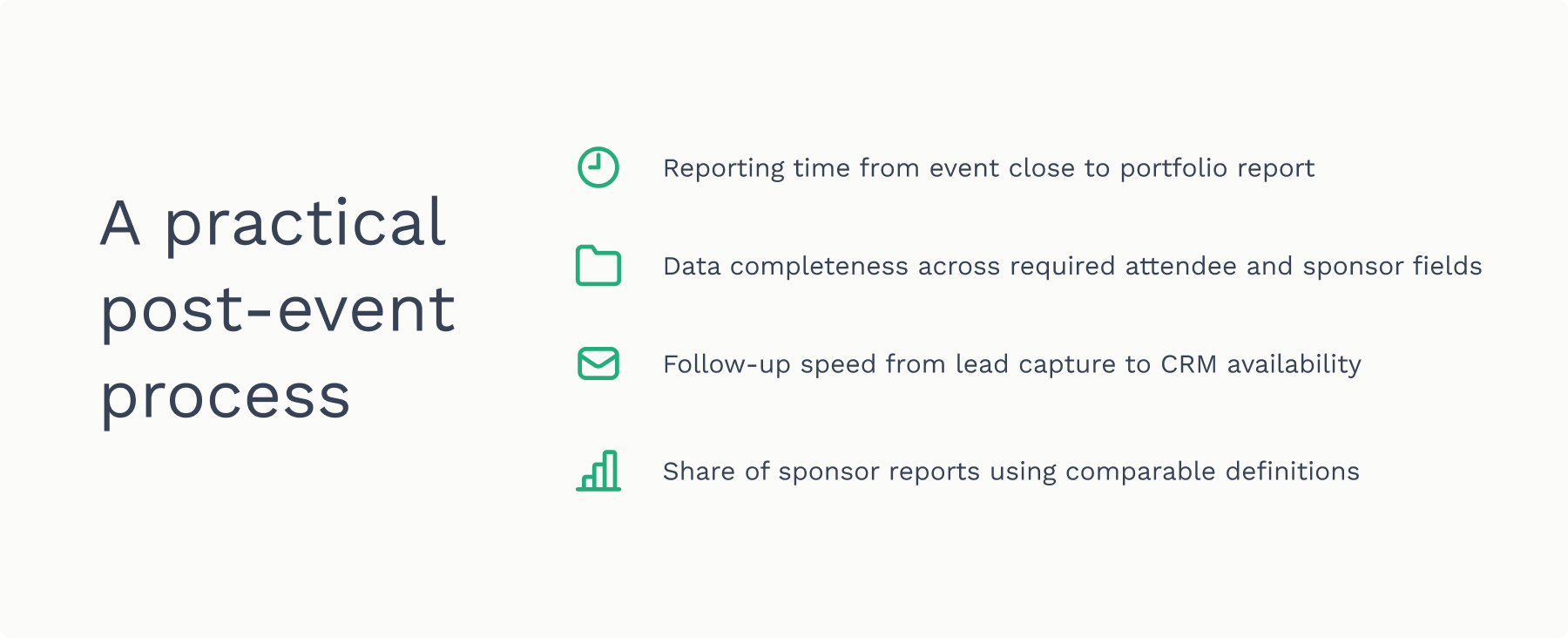
Get started with Swapcard with those baseline measures already documented, so the migration discussion focuses on evidence gaps and high-cost handoffs rather than a feature checklist.
Growing associations do not need to remove every specialist system. They need an event tech stack where each retained tool preserves identity, attribution, and reporting speed. Consolidate the joined core first, govern every remaining integration, and expand the team only after repeated handoffs stop consuming the portfolio.
FAQs
How do I calculate the true cost of my fragmented event tech stack?
Start with four auditable cost lines rather than license fees alone. First, count reconciliation hours spent matching records and correcting duplicate fields across events. Second, add integration upkeep, which is the time your team spends monitoring mappings, errors, and vendor changes. Third, measure reporting lag, the gap between an event interaction and a usable portfolio report. Fourth, flag evidence gaps where sponsor activity cannot be linked to meetings, leads, or follow-up. Multiply the internal hours by your association's loaded labor cost, then add vendor and integration spend. You do not need an industry-wide benchmark to make this useful. The point is to see how much repeated, manual work sits across events, membership, finance, and IT budgets so you can prioritize which handoff to fix first.
What if my chapters want to keep their own registration fields?
Chapter autonomy works when local choices do not break shared reporting. Separate required fields from configurable fields inside each template. Required fields feed cross-event analytics and use the portfolio definitions for registrations, attendance, meetings, and leads. Configurable fields support local programming, such as topic preferences, dietary questions, or local sponsor data, and do not alter the core calculations. Assign one portfolio owner for definitions and one local owner for execution, so the local team can shape the attendee experience without redefining board-level metrics. When a chapter needs something outside the template, run it through a simple exception process with an owner, reason, scope, and expiry date. The goal is comparable reporting across formats, not identical setups.
When should I keep a specialist tool instead of consolidating everything?
Full replacement is not always the right answer. Keep a specialist system when it adds distinct value the unified core cannot provide, such as a complex peer-review process or a specialized venue workflow. Specialist systems often hold years of configuration and staff knowledge, and removing them can create more risk than value. Before retaining any tool, run four checks: does it add a capability the core lacks, does it preserve your portfolio identity key, does data arrive within the required reporting window, and can your team detect and correct a gap before reporting closes. If any answer is no, the tool needs a revised, governed integration or a replacement plan. Consolidation should remove destructive handoffs, not useful expertise.
How do I make exhibitor lead reports actually reach exhibitors?
Only 3% of exhibitors download their lead reports within 90 days, according to Swapcard's State of Event Engagement Report Volume 2. That delay is not only an exhibitor behavior problem; it exposes a delivery gap. If lead retrieval requires a separate login or a manual export, you are placing the final step of ROI proof on the stakeholder with the least reason to manage another system. Set a delivery baseline before you consolidate: measure the time from lead capture to CRM availability, the share of exhibitors receiving usable reports, and the number of records with qualification context. The Swapcard Exhibitor Lead Center captures leads across channels and can sync them to the association's CRM system, so follow-up happens while interest is high rather than weeks later.
Can I consolidate my stack without replacing everything at once?
Yes, and a phased migration is usually the safer path. Full-portfolio replacement promises faster standardization but concentrates operational risk across every chapter and event format. Instead, score each handoff by staff hours per event, number of records requiring correction, days added to reporting, and sponsor evidence lost. Migrate the highest-scoring handoff first, then verify identity and attribution before expanding. A sensible sequence often starts with registration-to-profile data, followed by engagement-to-lead records and lead-to-CRM delivery, with reporting consolidation last. This gives your team a rollback point and creates measurable proof before the next workflow changes. Swapcard supports this sequence through Registration, its Developer API and Webhooks, the Exhibitor Lead Center, and Analytics and Reporting.
Why does my attendee data still require manual matching across systems?
The usual cause is missing identity matching, not missing features. A member can appear under a member ID in the AMS, an email address in registration, a profile ID in the event app, and a contact ID in the CRM. Without a durable matching rule, reconciliation becomes unavoidable. Test five records across the full journey, including a member, non-member, speaker, exhibitor representative, and hosted buyer. For each person, verify whether the same identity connects registration, session activity, meetings, lead capture, and follow-up. Pay particular attention to AMS integration, since member status affects pricing, access, and reporting. If a status change creates duplicate profiles or fails to update downstream access, you have several partial versions of the same attendee rather than one source of truth.

Bhavya Sharma
Senior Content Marketing Manager
Bhavya leads content strategy across the funnel at Swapcard, pairing flagship research with storytelling that turns awareness into pipeline.


Join 12,000 subscribers and unlock industry secrets.
By submitting this form, you agree to receive periodic emails on insightful content related to events and our product, and in accordance with our Privacy Policy. You can, of course, change your preferences or unsubscribe at any time.