Conference ticket pricing mistakes that drain association margin


You changed the headline rate, yet member overrides, overlapping tiers, and uncapped early-bird inventory still drain conference margin. Conference ticket pricing starts with enforceable registration rules and clean data that show exactly where revenue leaks.
The registration form is the association's first pricing control point. Treating it like a tax form leaves finance with disputed totals, registration teams buried in override requests, and onsite staff with access records that do not match what attendees purchased.
Key takeaways:
• Build every rate from costs, fees, taxes, attendance assumptions, and target margin
• Give each ticket tier a distinct audience or access purpose
• Cap early-bird and group discounts by deadline and inventory
• Verify member eligibility through the association management system
• Track registration abandonment by tier and form step
• Govern pricing through one audit-ready matrix
The fastest way to find those leaks is to audit the registration logic before revisiting the headline rate.
Where your conference margin actually leaks before the event opens
The revenue gap rarely shows up in the headline rate. It shows up in a member discount applied without an eligibility check, an early-bird tier that stayed open three days past deadline, and a group buyer who paid but could not assign tickets. Changing the price solves none of those.
Audit logic before headline rates
A registration manager opens the support queue after an early-bird deadline and finds the same requests she saw last year. A member received the public rate, a non-member used a forwarded code, and a group buyer cannot assign purchased tickets. Finance wants an explanation, the conference team wants to adjust the headline price, and neither request will fix the actual leak.
Changing the rate corrects none of those issues. Map each ticket against five controls instead: audience, eligibility, deadline, inventory, and margin. If a tier cannot be described in one row using those fields, its logic is not ready for sale.
Competitor prices offer useful market context, but copying them ignores the association's cost base and member model. Pricing discipline starts with internal economics and tier-level performance, not another conference's price sheet.
Complexity compounds downstream errors
Pricing tickets to drive more sales and higher revenue has two recurring issues: too many ticket types and overly aggressive early-bird discounts. Extra choices slow the buyer, generate support questions, and fragment reports across options that often serve the same audience. The problem grows when staff apply manual overrides without a consistent reason code.
Test the pricing structure against actual access rules before launch. If several tickets point to the same access rules but carry different names and prices, registration staff cannot explain the difference at the desk. Onsite teams inherit the confusion when a badge grants the wrong access or forces a correction while a line builds behind it.
Registration managers comparing how pricing rules connect with attendee records and onsite access can review Swapcard's registration and access control features. The immediate goal is not a new rate. It is a registration structure that produces an answer finance and operations can both verify.

Every rate needs a floor
Every conference rate needs a documented floor built from actual event economics. Direct costs, expected attendance, and target margin determine whether a tier works.
Calculate the true price floor
A price floor is the lowest net rate that still protects the planned margin for a ticket. Start with the costs that change with each attendee, then allocate the fixed costs the ticket mix has to recover. Include the fees that disappear from the gross sale before finance ever sees the net amount.
Run the calculation in a fixed order:
- Add the direct per-attendee costs tied to the ticket
- Allocate a share of venue, content, staffing, and technology costs
- Add payment fees, taxes, and other required charges
- Apply the planned margin for that tier
- Compare the floor with the net amount received after discounts
To illustrate: if a general admission ticket carries $60 in direct costs and a $40 share of fixed costs, and the payment processor takes 3%, the floor before margin sits at roughly $103. A $275 full-price ticket has room for a tiered discount. A $95 ticket does not.
A member ticket can sit below the public rate because membership dues support a different economic model. That is valid. The association still needs to know whether the conference rate covers its assigned costs or relies on a documented subsidy, because the two answers lead to different renewal conversations with finance.
Stress-test attendance assumptions
One attendance forecast is not enough for an event pricing strategy. Test the expected tier mix under a base case, a downside case, and the venue capacity limit. Fixed-cost coverage moves faster than the headline attendance number suggests, which is exactly where a rate that looked safe starts losing money.
For each case, calculate how many registrations land in early-bird, member, and non-member tiers, then account separately for group and complimentary. Compare gross revenue, allocated costs, and margin side by side. If the downside case pushes a paid tier below its floor, revise the discount or the inventory limit before launch, not after the first support ticket.
Validate fees, attendance assumptions, and tier simplicity before setting rates. Late changes create new communications, refund questions, and reconciliation work. Rate approval belongs at the end of the model, not at the beginning.
Fewer tiers improve pricing control
Fewer conference pricing tiers improve control when every remaining ticket serves a distinct audience or access requirement. Removing redundant options reduces buyer hesitation and hands registration teams cleaner reports. Three tiers—member, non-member, and VIP—each with a distinct audience and access rule, produce a cleaner buyer decision than six tiers where the difference only makes sense to the registration team.
Give every tier one job
A ticket tier needs one clear job. It can identify an audience, verify a pricing benefit, control availability, or grant specific access. Combining several unrelated purposes in one ticket makes the logic almost impossible to test.
Review each tier against four checks: who qualifies, what price applies, when it opens and closes, and what access it grants. If two tickets produce the same answers to all four, merge them unless finance has a documented reporting requirement. A VIP ticket with a private workshop and reception serves a different purpose from general admission. Two general admission tickets with different internal labels do not, and attendees cannot select correctly when the distinction only makes sense to the registration team.
Separate access from discounting
Price differences and access differences should not share a rule unless the business reason requires both. A member discount changes what an eligible attendee pays. A workshop ticket changes what the attendee can enter. Treat those as the same decision, and you create avoidable access corrections at the door.

Map access permissions separately from the price table. A buyer can receive a discount without receiving premium-session access, and a complimentary speaker can receive access without creating paid revenue. Keeping those rules distinct protects segmentation and badge accuracy.
Accurate audience and interest data from a clean registration flow gives event teams better inputs for attendee communications, session recommendations, and structured meetings. Those records carry operational value into every post-event workflow that depends on knowing who attended and why.
Measure each tier independently
A tier that sells well can still weaken margin. Measure volume, net revenue, support cases, and override count for every ticket type, because gross sales alone hide the effect of discounts and manual changes.
Compare each tier with the role assigned to it. If an early-bird ticket exists to move demand earlier, track when those registrations actually occur. If a member tier supports retention, track verified member registrations separately from code-based exceptions. If a group rate targets team buyers, track purchased seats and assigned attendees as different stages.
Tier-level reporting also exposes naming problems. A ticket that generates repeated support questions needs clearer language or simpler rules, even when sales stay strong. Registration data with tier-level breakdowns replaces post-mortem speculation about why a rate underperformed.
Discount controls preserve full-price demand
Discount controls preserve full-price demand by limiting who receives a reduced rate, how many discounted tickets exist, and when the offer ends. Early-bird and group rates work when they reward useful buying behavior. Open-ended concessions train buyers to wait for the next exception.
Cap early-bird exposure
Early-bird ticket pricing has a valid purpose. It brings cash forward, improves planning, and tests demand before larger venue commitments become fixed. None of those benefits justify leaving discounted inventory uncapped.
Set both a date limit and a quantity limit, then close the tier when either condition arrives first. For a conference targeting 400 attendees, capping early-bird at 100 tickets limits discounted sales to 25% of capacity. If demand exceeds the cap, remaining buyers pay full price. If it falls short, the deadline still ends the discount before the pattern becomes an expectation. A deadline alone leaves the association exposed if unusually high demand floods the discounted tier. An inventory cap alone gives buyers no reason to act early.
Evidence on association-specific cannibalization rates remains limited, so registration teams should not invent a benchmark. Track the share of sales by pricing period and compare it across editions instead. If discounted volume rises while total attendance stays flat, the rate is shifting existing demand rather than creating new demand.
Protect group-sale margin
Group pricing trades margin per ticket for a larger commitment and lower acquisition effort. That trade is reasonable when the minimum quantity, discount floor, and assignment process are clear. It breaks down when staff negotiate each group differently.
Set a minimum purchase quantity and a fixed discount schedule. Record the buyer separately from each attendee, and define the assignment deadline before onsite badge production begins. Group registration needs a replacement process too, since team rosters often change after payment.
Assignment complexity can erase the operational value of a group sale. If a team buyer purchases 10 seats but spends the following two weeks emailing to assign names, registration staff absorb that cost in manual corrections. Assessing how the current registration platform handles group records and downstream access rules before the next launch prevents that cost from repeating.
Eligibility rules replace manual exceptions
Eligibility rules replace manual exceptions by checking status before showing a protected rate. Association management system (AMS) integration, conditional registration paths, and governed exception codes keep member pricing consistent. The same verified record then supports access and finance reporting.
Verify members through the AMS
Member versus non-member pricing requires a reliable source of eligibility. A reusable promo code proves that someone received the code, not that the buyer holds an active membership. Forwarded codes and staff overrides weaken both margin control and audit quality.
Use the AMS as the source for membership status when an integration is available. Verify the person before displaying or applying the member rate, and record the result with the registration. If the AMS record is uncertain, route the registration for review rather than defaulting to a discount.
Promo codes still have a place for approved campaigns and documented exceptions. Good promo code governance limits each code by audience, ticket, use count, and expiration, and finance should receive a reason for every exception category.
Use conditional registration paths
Conditional logic protects eligibility and data quality while cutting irrelevant fields. Member buyers see member pricing and relevant questions after verification. Exhibitors, speakers, hosted buyers, and general attendees follow different paths without facing one oversized form.
The Swapcard webinar registration strategies that work frames the principle plainly: ask only for information the event team will use soon, then show additional fields when an answer makes them relevant. A shorter path reduces the number of places where an attendee can enter conflicting information.
Moderated registration adds work, and that limitation matters. It fits invite-only audiences or uncertain eligibility, not every buyer. Apply manual review to exceptions while verified registrations continue through the standard path.
Preserve downstream access accuracy
Verified status should drive both price and ticket access rules from the same attendee record. A member workshop purchase, speaker pass, or hosted buyer ticket then carries the correct permissions into session access and badge printing, and staff do not need to interpret handwritten notes at the desk.
Access errors usually reveal pricing logic gaps too late. An attendee arrives onsite with a receipt for one tier and a badge tied to another, leaving registration staff to settle the record in front of a waiting line. Correcting the source rule before launch costs far less than fixing each record onsite.
A single attendee profile also supports cleaner revenue reconciliation. Finance can trace who qualified, what they paid, which exception applied, and what access followed. Audit-ready pricing depends on that chain staying intact.
Tracking turns leakage into action
Funnel events show where buyers stop. Tier reports show which rates underperform. A single governed matrix keeps registration, finance, leadership, and onsite teams on the same version. Registration data with funnel breakdowns replaces the post-event speculation about why a tier underperformed.
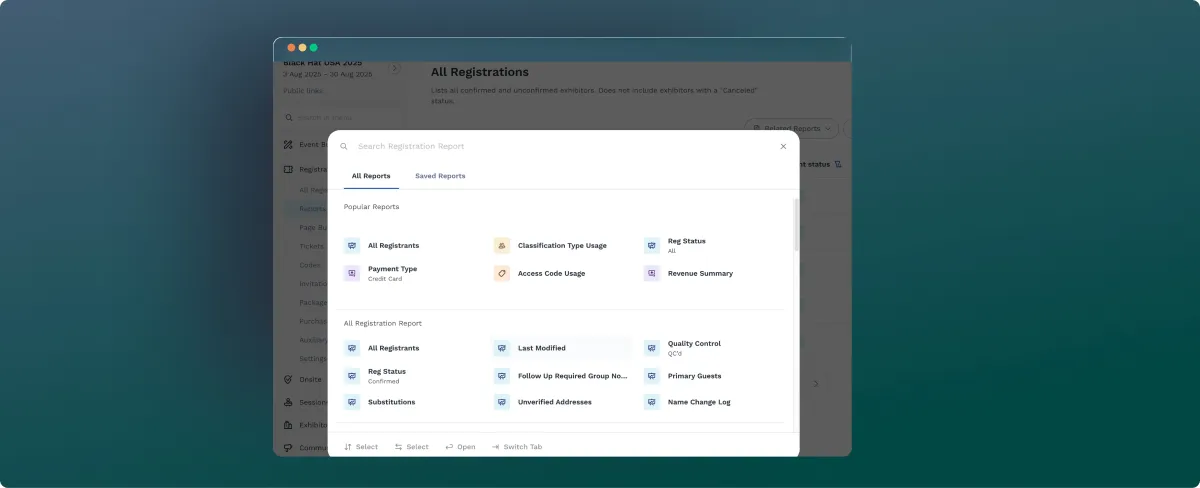
Instrument the registration funnel
The Swapcard webinar Love at First Click: Registration Strategies That Work states that most registration abandonment is silent, which is why teams need tracking rather than anecdotal diagnoses. A buyer closes the tab, and no support ticket explains whether the cause was price, form length, eligibility, fees, or payment. Abandonment stays invisible unless the flow records where it happened.
Track at least four points:
- Ticket selection viewed
- Registration form started
- Payment started
- Registration completed
Break those events down by tier, audience, device, and form step. Abandoned-registration tracking has limits in some systems, including reminder caps and no retroactive data, so confirm the available history before drawing conclusions. Instrumentation must exist before the buying window if you expect useful evidence afterward.
Separate price from form friction
Price friction and form friction leave different fingerprints. A drop immediately after ticket selection points toward the offer, rate, or fee display. A drop after several form pages points toward field burden, eligibility confusion, or a technical fault.
Review abandonment by pricing tier and step, then compare it with support cases. Member drop-off after an eligibility check deserves a different response from public buyers leaving at payment. One calls for an AMS data review. The other calls for fee and payment-path testing.
Fragmented systems make that analysis harder because totals have to be rebuilt after the fact. Staff hours spent reconciling registration, payment, and access records are a real cost that rarely appears in technology evaluations.
Govern one pricing matrix
One pricing matrix should hold the approved logic for every tier. Include audience, eligibility source, gross price, deadline, access permissions, and exception owner as core columns, then add version history and approval dates so late changes stay traceable.
Swapcard's Registration, Tickets, and Analytics features support parts of that governed process: conditional forms show questions by attendee type or ticket, ticket rules apply time-based pricing and quantity caps, and registration reporting shows ticket mix, revenue, and abandoned registrations. Product support does not replace pricing judgment, though. Conditional logic and abandoned-registration recovery are paid add-ons, recovery allows one reminder, and no retroactive abandonment collection is available. In-app paid registration uses Stripe with one currency and one tax rate per event, so test those boundaries against the matrix before launch.
Clean registration records keep reconciliation and onsite access aligned after the payment clears. Registration managers ready to connect an approved pricing matrix with live ticket rules can get started with Swapcard.
Work the audit in order: remove redundant tiers, calculate each floor, cap discounted inventory, verify member status through the AMS, and track abandonment by step. Conference ticket pricing improves when every rate has an enforceable reason and a measurable outcome. The final matrix gives finance a defensible revenue model, leadership a clear approval record, and onsite teams accurate attendee access. Pricing discipline begins in the registration logic.
FAQs
How do I verify member eligibility without relying on promo codes?
Use your association management system (AMS) as the source of truth for membership status, not a reusable code. A forwarded code proves someone received it, not that the buyer holds an active membership. Verify the person before you display or apply the member rate, then record the result with the registration. If the AMS record is uncertain, route that registration for manual review rather than defaulting to the discount. Swapcard supports AMS integrations and conditional registration flows, so member buyers see member pricing and relevant questions only after verification. Keep promo codes for approved campaigns and documented exceptions, and limit each code by audience, ticket, use count, and expiration so finance can trace every exception.
What if my early-bird tier keeps cannibalizing full-price sales?
Cap the exposure. Set both a date limit and a quantity limit, then close the tier when either condition arrives first. A deadline alone leaves you exposed if unusually high demand floods the discounted inventory, and a quantity cap alone gives buyers no reason to act early. You need both. Hard association-specific cannibalization benchmarks are limited, so do not invent one. Instead, track the share of sales by pricing period and compare it across editions. If discounted volume rises while total attendance stays flat, the rate is shifting existing demand rather than creating new demand. That signal tells you to tighten the cap or shorten the window before the next launch, not after the support tickets start.
How do I calculate a true price floor for each ticket tier?
Build the floor from actual event economics in a fixed order. First, add the direct per-attendee costs tied to the ticket. Second, allocate a share of venue, content, staffing, and technology costs. Third, add payment fees, taxes, and other required charges. Fourth, apply the planned margin for that tier. Fifth, compare the floor with the net amount you actually receive after discounts. A member ticket can sit below the public rate because membership dues support a different model, but you still need to know whether the conference rate covers its assigned costs or relies on a documented subsidy. Those two answers lead to different renewal conversations with finance, so document which one applies to each tier.
Can I tell whether registration drop-off is caused by price or by the form?
Yes, if you instrument the funnel before the buying window opens. Price friction and form friction leave different fingerprints. A drop immediately after ticket selection points toward the offer, rate, or fee display. A drop after several form pages points toward field burden, eligibility confusion, or a technical fault. Track at least four events: ticket selection viewed, form started, payment started, and registration completed, then break them down by tier, audience, and step. Swapcard's registration reporting shows ticket mix, revenue, and abandoned registrations. Note the limits though: abandoned-registration recovery is a paid add-on, allows one reminder, and offers no retroactive collection, so confirm your available history before drawing conclusions.
When should I merge two ticket tiers instead of keeping both?
Merge them when they do the same job. Review each tier against four checks: who qualifies, what price applies, when it opens and closes, and what access it grants. If two tickets produce identical answers to all four, combine them unless finance has a documented reporting requirement for keeping them separate. A VIP ticket with a private workshop and reception clearly serves a different purpose from general admission. Two general admission tickets with different internal labels do not, and attendees cannot select correctly when the distinction only makes sense to your registration team. Extra choices slow the buyer, generate support questions, and fragment reporting. Cleaner tier logic also produces cleaner attendee records, which keep onsite access and finance reconciliation aligned after payment clears.
How do I keep group registration from creating onsite badge chaos?
Define the assignment process before badge production begins. Set a minimum purchase quantity and a fixed discount schedule so staff do not negotiate each group differently. Record the buyer separately from each attendee, and build in a replacement workflow, since team rosters routinely change after payment. Set an assignment deadline early enough that names are locked before onsite badge printing. Assignment complexity can erase the operational value of a group sale: if a team buyer purchases seats but cannot assign names without repeated emails, your registration staff absorb the cost. Swapcard connects group registration, ticket records, and downstream access rules, so verified assignments carry the correct permissions into badge printing rather than leaving staff to interpret notes at the desk.

Bhavya Sharma
Senior Content Marketing Manager
Bhavya leads content strategy across the funnel at Swapcard, pairing flagship research with storytelling that turns awareness into pipeline.





Join 12,000 subscribers and unlock industry secrets.
By submitting this form, you agree to receive periodic emails on insightful content related to events and our product, and in accordance with our Privacy Policy. You can, of course, change your preferences or unsubscribe at any time.