Event technology trends for modern operations

Your portfolio review stalls when registration, the association management system (AMS), and lead retrieval assign different records to the same member. That mismatch weakens every event technology decision that follows, because leadership cannot connect engagement activity to sponsor value or exhibitor return on investment (ROI).
Adding another artificial intelligence (AI) feature will not repair broken data. Association leaders gain a stronger operating advantage by enforcing a single data model and a single reporting language across the portfolio, even when local event teams prefer specialized tools.
Key takeaways:
- Tool consolidation creates shared data definitions and fewer manual handoffs across an event portfolio
- AI assistants produce useful recommendations only when profile and behavioral signals remain connected
- Registration data quality determines downstream segmentation, activation, and matchmaking performance
- Standardized portfolio reporting turns event activity into sponsor and board evidence
- Structured meeting programs make buyer and exhibitor outcomes measurable at scale
Why your sponsor reports never match what your team saw at the event
When the registration file, the app export, and the lead retrieval report each assign a different identity to the same member, the post-event reporting week becomes a reconciliation project instead of an analysis. Each handoff changes, delays, or separates the data required for attribution, preventing leadership from connecting engagement activity to sponsor value.

Manual handoffs create conflicting truths
A director closes an association's annual meeting on a Friday and opens three exports the following Monday morning: registration uses member IDs, the app uses email addresses, and lead retrieval groups exhibitor contacts by booth staff. The event team then spends most of that week deciding which numbers belong together before it can answer a basic question about exhibitor value, and the renewal deck slips a week as a result.
Think of the attendee record as the badge passed through a relay. Registration, matchmaking, and lead capture each need to carry the same identity forward. If one system drops that identity, the final lead total no longer connects to the member journey that created it.
Audit the event technology stack by counting every export, import, duplicate check, and field conversion between systems. A handoff warrants attention when staff must rename fields, match records manually, or wait for another team before reporting an outcome. Those steps signal a data continuity gap, not a minor administrative task. Count them once, and most portfolios find between six and eight manual handoffs hiding inside a single event.
Consolidation must improve attribution
Creating a single dependable path from registration through engagement to lead outcomes is the objective, and that distinction should govern every platform decision. Consolidation earns its cost only when it improves attribution, AI inputs, or renewal evidence. Reducing the number of tools is a side effect of that work, not the goal.
Standardize suites with clear exceptions
Suite standardization gives association portfolios shared fields and metric definitions. Specialist products still have a valid role when an event requires a capability that the standard suite cannot support. That exception is reasonable when it carries a measurable requirement rather than a local preference.
Before approving an exception, event leaders should test four points:
- Confirm which required workflow the standard suite cannot support
- Name the metric that the specialist product must improve
- Document how identity and activity data will return to the portfolio record
- Set a review date for keeping or removing the exception
If the specialist tool cannot return usable attendee, company, or lead data, then its functional depth creates a reporting gap elsewhere. Event technology consolidation earns its place when specialist depth and portfolio accountability can coexist.
Assign migration and integration ownership
Migration risk sits in the spaces between systems. A registration vendor may own the form, an AMS team may own member status, and an event app provider may own activity records. Without a single person accountable for each connection, each party can complete its own task while the overall data flow remains broken.
Assign an owner to every integration before procurement. Record the sending system, receiving system, and identity key, along with required fields, update timing, and the process for rejected records. Without that documentation, integration failures trace back to no one, and fixes require reconstructing decisions that were never written down.
A migration plan should also cover event tiers. A flagship annual meeting may require deeper integrations than a regional workshop, yet both still require the same member ID and portfolio metrics. Standardize the data contract first, then adjust the operational depth by event type.
Registration anchors the portfolio data model
Registration anchors the portfolio data model by creating the first usable identity record for each attendee. Member status, ticket type, interests, and company details shape every later workflow. Poor registration data weakens segmentation, matchmaking, and exhibitor reporting before the event begins.
Balance completion with usable data
Short forms support completion, but collecting too little information leaves downstream systems without the inputs they need. Long forms create the opposite problem by asking every audience the same questions. Registration design must collect only the minimum data required for the next 30 days of operations.
Conditional logic resolves much of that tension. Members see verified pricing questions, exhibitors see booth and staff fields, and hosted buyers see qualification questions. General attendees do not need any of those. The form shortens for each audience without losing the data that drives matching and access.
Registration shortcuts surface later as broken segmentation, lower adoption, and weaker exhibitor matches. Apply one test to every field before launch: remove any field that has no named downstream use, and add any field required for access, targeting, or matching.
Match identity across the lifecycle
Identity matching connects the AMS, registration flow, engagement records, and exhibitor leads to the same person and company. Email alone is an unstable key. Members change employers, use assistants, and register with alternate addresses. The member ID should stay the primary association identifier, with documented fallback rules for nonmembers and guests.
Set field ownership before any data starts moving. The AMS should govern member status, while registration governs event-specific selections and ticket records. Engagement systems should attach behavioral signals to that identity rather than create a separate attendee record.
An identity policy codifies the decisions that prevent duplicate profiles from accumulating across the portfolio. A practical policy covers four decisions:
- Define the primary person and company identifiers
- Set rules for duplicate detection and record merging
- Decide which system can update each field
- Preserve source and timestamp information for every change
First-party data becomes commercially useful only when event teams can connect it across the lifecycle. Without that connection, even accurate records remain isolated facts.
Connected signals make AI useful
Connected profile and behavior data make AI event assistants useful because recommendations depend on context. A complete profile supplies stated interests, while searches, bookmarks, and meetings reveal actual behavior. Combining both produces stronger recommendations than either source alone can provide.
Keep assistants assistive before autonomous
AI assistants should begin with recommendation and navigation tasks, not autonomous operational decisions. Assistive tools can suggest people, sessions, or exhibitors while attendees and organizers retain control. Autonomous actions require stronger data quality, permissions, and review rules.
Use a simple gate for autonomy. Keep the assistant in an assistive role if profiles are incomplete, if identity matching remains inconsistent, or if event teams cannot explain which data shaped the output. Expand its role only when actions are reversible, logged, and governed by clear permissions.
Sparse data sets a firm limit. No AI system can infer member intent from an email address and a ticket type alone. Recommendation quality improves when profile information and behavioral signals remain attached to a single attendee record throughout the event journey.
Activate networking before arrival

Pre-event activation is an operating requirement because up to 65% of in-person networking happens before the event. The State of Event Engagement Report Volume 2 shows why waiting until onsite leaves a large share of connection activity unsupported.
Open the networking environment early enough for attendees to complete profiles, review exhibitors, save sessions, and request meetings. A late launch compresses those actions into the days when event teams already face speaker changes, exhibitor questions, and onsite preparation.
Track pre-event app activation against profile completeness and meeting activity. If activation increases but completed profiles and accepted meetings remain flat, the audience has logged in without receiving sufficient practical value. That gap usually points to a profile enrichment opportunity or a clearer explanation of what attendees gain from completing the steps before they arrive.
Count behavior as lead intent
Badge scans capture direct contact, but they do not capture the full commercial journey. Three-quarters of event leads come from digital interactions outside traditional badge scanning, according to the same event engagement research. Lead reporting must include behavioral signals rather than treating scans as the only valid outcome.
Define lead intent before configuring reports, since each signal type represents a different level of commercial interest: a profile view indicates discovery, a bookmark indicates saved interest, and a completed meeting indicates direct action. Session activity can also reveal sponsor relevance when the attendee never visits the booth.
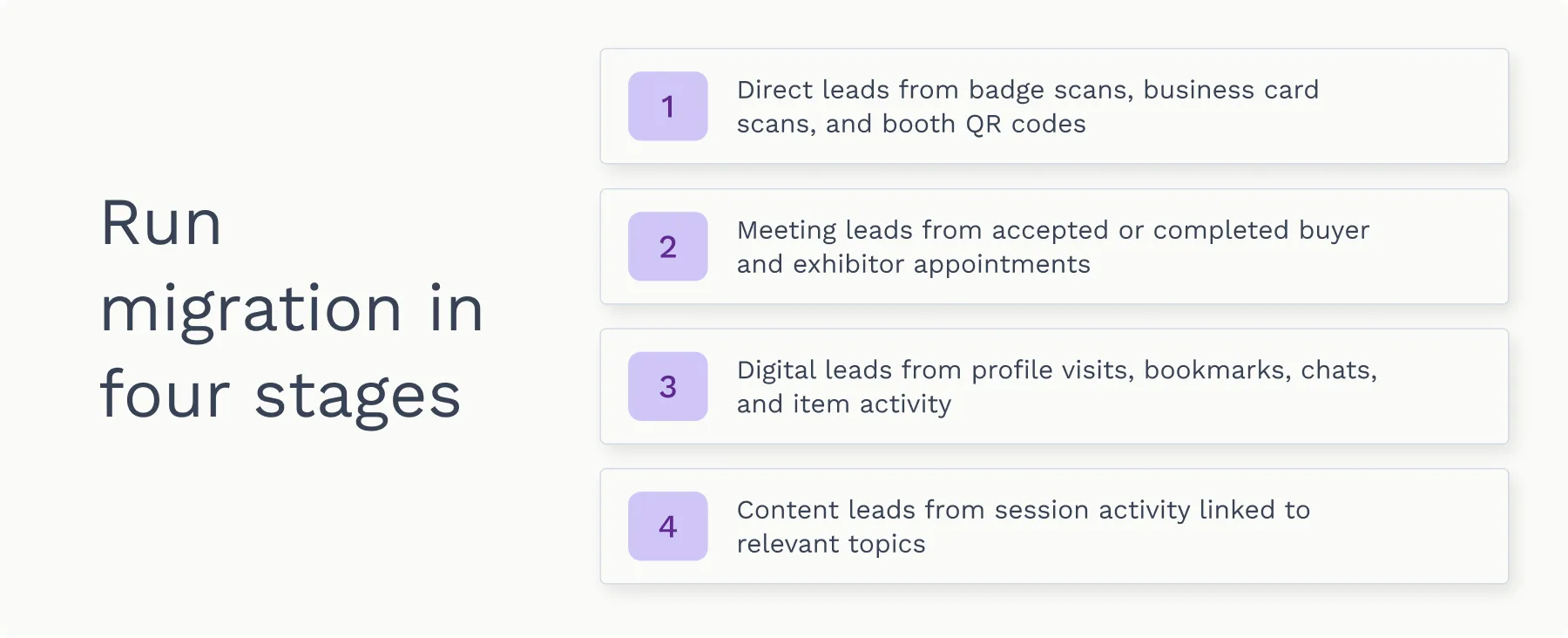
Association event teams need lead reporting that includes digital behavior, not just scans. Connected identity is what makes those digital actions useful for exhibitor ROI.
Structured meetings create reportable outcomes
Structured meetings make event ROI reportable by producing booked, held, and attributed outcomes that can be compared across events and sponsors. Association organizers can compare meetings booked, meetings held, and leads attributed across events. Sponsors gain clearer evidence than a general engagement total provides.
Codify buyer and scheduling rules
Buyer qualification should reflect commercial relevance, not job title alone. Define purchasing authority, stated interests, sourcing needs, and participation expectations before opening selection. A larger buyer pool does not improve a hosted buyer program if exhibitors cannot identify relevant demand.
Scheduling rules protect quality once volume rises. Set request limits, meeting windows, buyer availability, and minimum profile requirements before matching begins. If an event cannot explain why two participants were matched, the workflow needs better qualification data or clearer rules.
Track completion and lead attribution
Tracking both booked and held meetings captures demand alongside operational delivery. Add meeting acceptance, attendance, qualification score, and lead attribution so exhibitors can separate scheduled activity from useful conversations. That chain of evidence is what makes a meeting report worth presenting at renewal.
Association event teams should agree on the definition of a completed meeting before launch. A calendar booking alone is not completion. Require an attendance record or participant confirmation, then link the meeting to the relevant buyer and exhibitor records.
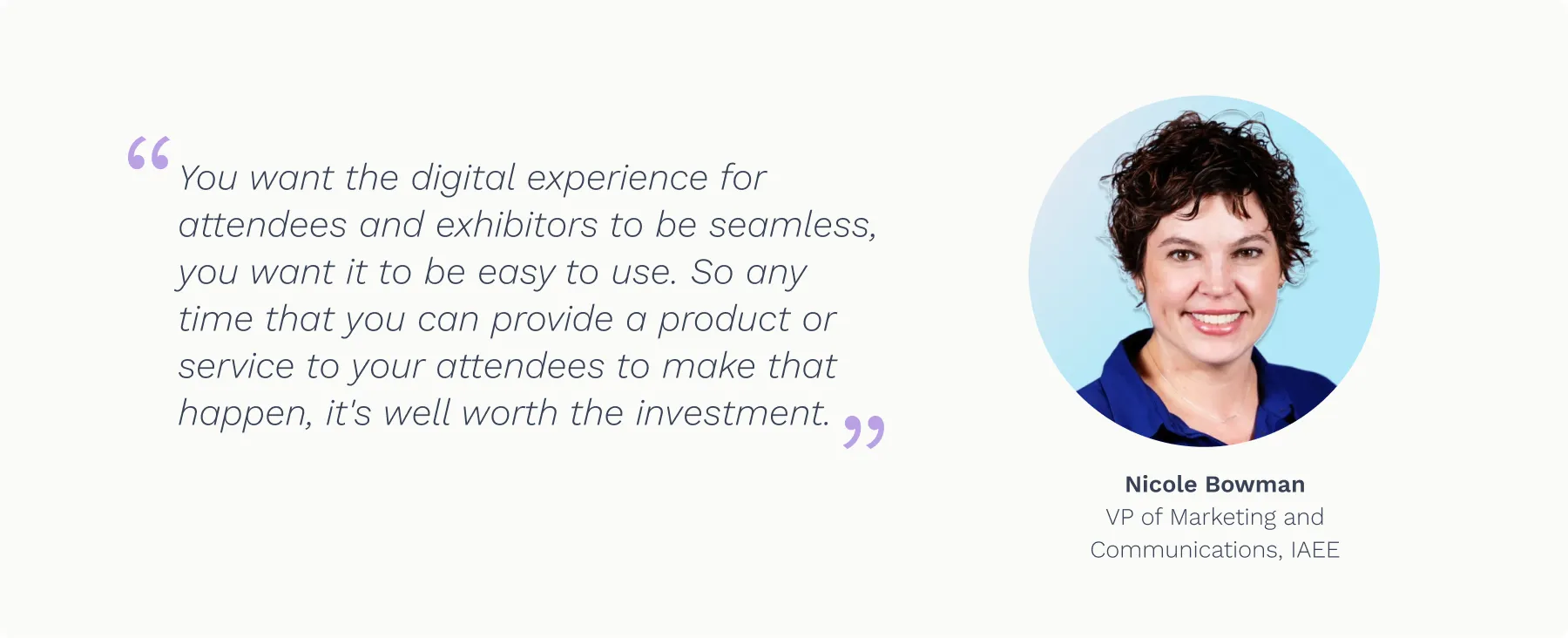
The investment becomes easier to defend when meeting delivery and lead quality appear in the same evidence set.
PCMA proves repeatable execution
PCMA case study image
PCMA shows how standardized meeting operations produce a reportable commercial outcome. During its Convening Leaders Hosted Buyer program, the organization used defined buyer selection, scheduling, and onsite execution workflows rather than coordinating the program through separate spreadsheets.
In Swapcard's documented case study of PCMA Convening Leaders, all 244 scheduled meetings took place, producing a 100% completion rate. That measure gives association leaders a repeatable benchmark for delivery, not another broad networking count.
Meeting programs should report a short chain of evidence, because each step answers a different question about program quality — condensing them into a single attendance count misrepresents what the program actually delivered:
- Qualified buyers approved
- Meetings requested and accepted
- Meetings scheduled and held
- Leads created and attributed
- Participant satisfaction recorded

Shared governance makes evidence comparable
Shared governance makes portfolio evidence comparable by defining required templates, fields, and metrics across all events. Local teams can retain justified flexibility, but portfolio measures must keep the same meaning. Otherwise, a chapter conference and an annual meeting may report identical labels for different activities.
Govern templates without erasing flexibility
Portfolio governance should separate required elements from optional ones. Registration identity fields, attendee types, and lead definitions belong in the required layer. Local agenda labels, sponsor packages, and chapter-specific questions can remain configurable.
Local flexibility has real value. Chapter teams often understand their audiences and operating limits better than a central office does. Still, flexibility should not alter the definitions used for app activation, qualified leads, completed meetings, or sponsor delivery.
Require every exception to have an owner, a reason, and an end date. If a local variation changes a portfolio metric, central leadership should approve it before launch rather than reconcile the difference afterward.
Separate operating and evidence views
Real-time operating dashboards and board reports serve different decisions. An onsite dashboard needs check-ins, room attendance, app activation, and meeting status. A board, sponsor, or renewal report needs trend comparisons, commercial outcomes, and a clear link between investment and value.
Do not force one dashboard to serve both audiences. Instead, define a shared metric layer and present it through separate views. Industry benchmarks add context, but each association still needs stable internal definitions across its own events.
In GDC data consolidation reporting, Patrick Shields of Informa Tech described the direct payoff of connected reporting: "Swapcard helped us with the integration of data across our different business units, and has helped my team save two weeks of work per event." Two weeks saved per event is the difference between reconciling last year's data and planning next year's improvements.
HLTH connects adoption and leads
HLTH demonstrates why adoption and lead activity should appear together. The HLTH 2025 results show 91% active usage and 29,873 exhibitor badge scans, with scans increasing 18% year over year.
Those figures do not treat app activity as an isolated success measure. Adoption created a larger base for networking, discovery, and exhibitor interaction, while lead activity supplied a commercial measure. Portfolio reporting should make the same connection rather than placing adoption and exhibitor outcomes in separate reports.
HLTH Event Director Matt Baum explained the operating goal: "We're bringing the right people in the right ecosystem together and giving them the opportunity to engage digitally. It gives them the opportunity to take advantage of everything the event has to offer." Comparable evidence shows whether that opportunity produces measurable action.
A three-part roadmap sets priorities
A three-part roadmap sets priorities by sequencing consolidation, AI readiness, and standardized reporting. Association leaders should start with broken handoffs, then improve the data used by recommendations, and finally define the evidence for boards and renewals. Named owners and success indicators keep each investment accountable.
Audit breaks before selecting tools
Audit every portfolio event against a single operating model before issuing a request for proposals. Map the attendee journey from AMS record through registration, app activity, meetings, lead capture, and reporting. Mark every point where staff export data, change identifiers, or reconcile totals by hand.
Rank each gap against three tests:
- Does the investment remove a manual handoff or conflicting record
- Does it improve the profile or behavioral data used by AI
- Does it strengthen evidence for sponsor renewals or leadership reporting
A product should meet at least one test and avoid weakening the other two. Event technology trends matter only when they improve how the portfolio runs and how value is proven.
Name owners and success indicators
Assign one owner to consolidation, one to AI readiness, and one to reporting standards. For each workstream, record the current gap, target workflow, required data, success indicator, and review date. Event technology trends become manageable when leaders convert them into owned operating decisions.
A unified platform does not replace an AMS, CRM system, marketing automation, or venue operations. Its role is to preserve identity and activity across registration, AI recommendations, lead capture, and reporting while APIs and webhooks move relevant records to external systems. Association leaders ready to test that against their own portfolio can get started with Swapcard by mapping the first broken handoff and defining the evidence that must improve.
The priority is a portfolio model that connects registration, member identity, engagement, meetings, and leads well enough to guide operations and withstand scrutiny during renewal.
FAQs
How do I count the manual handoffs in my event tech stack?
Start by mapping the attendee journey from your AMS record through registration, app activity, meetings, lead capture, and reporting. Then count every point where staff export data, import it somewhere else, run a duplicate check, or convert a field between systems. A handoff deserves attention when your team must rename fields, match records by hand, or wait for another team before it can report an outcome. Those steps signal a data continuity gap, not routine admin work. Most portfolios find between six and eight manual handoffs hidden inside a single event once they look closely. Count them once per event type, since a flagship annual meeting often has deeper integrations than a regional workshop.
What if a local chapter team wants to keep a specialist tool?
A specialist tool can stay when an event requires a capability your standard suite cannot support, but that exception must be backed by a measurable requirement rather than a local preference. Before you approve it, test four points: confirm which required workflow the standard suite cannot handle, name the metric the specialist product must improve, document how identity and activity data will return to the portfolio record, and set a review date. If the tool cannot return usable attendee, company, or lead data, its depth creates a reporting gap somewhere else. Assign one owner to that exception and require it to have a reason and an end date so central leadership can keep or remove it on schedule.
When should I open my event app before the event?
Open the networking environment early enough for attendees to complete profiles, review exhibitors, save sessions, and request meetings before they arrive. Pre-event activation is an operating requirement because up to 65% of in-person networking happens before the event, according to Swapcard's State of Event Engagement research. A late launch compresses those actions into the days when your team is already facing speaker changes and onsite prep. Track pre-event activation against profile completeness and accepted meetings, not logins alone. If activation rises but completed profiles and meetings stay flat, people have logged in without getting enough practical value. Behavior-driven recommendations depend on connected profile and activity data, so early activation also gives AI matchmaking the signals it needs.
Can I count digital interactions as leads, not just badge scans?
Yes, and you typically should. Three-quarters of event leads come from digital interactions outside traditional badge scanning, so reporting only on scans understates exhibitor value. Define lead intent before configuring reports: a profile view indicates discovery, a bookmark indicates saved interest, and a booked meeting indicates direct action. Session activity can also reveal interest in a sponsor's topic even when the attendee never visits the booth. Separate your reporting into direct leads from scans and QR codes, meeting leads from accepted appointments, digital leads from profile visits and chats, and content leads from session activity. This only works when identity stays connected across registration, engagement, and lead capture, so the digital signal ties back to a real person and company.
How do I make reporting comparable across a whole event portfolio?
Separate required elements from optional ones. Registration identity fields, attendee types, lead definitions, and core metrics belong in a required layer that maintains the same meaning across all events. Local agenda labels, sponsor packages, and chapter-specific questions can stay configurable. Require every exception to have an owner, a reason, and an end date, and if a local variation would change a portfolio metric, get central approval before launch rather than reconciling afterward. Then build separate views for separate audiences: an onsite operating dashboard needs check-ins and meeting status, while a board or renewal report needs trend comparisons and commercial outcomes. Swapcard's analytics can consolidate registration, check-in, sessions, meetings, and exhibitor leads into a single reporting layer, so both views draw from the same definitions.
Why does registration data quality matter so much for AI recommendations?
Registration creates the first usable identity record for each attendee, and recommendation quality depends on that context. A complete profile supplies stated interests, while searches, bookmarks, and meetings reveal actual behavior. No AI system can infer intent from an email address and a ticket type alone. Registration shortcuts show up later as broken segmentation, lower app adoption, and weaker exhibitor matches. To protect quality, use conditional logic so members, exhibitors, and general attendees only see relevant fields, and apply one test before launch: remove any field with no named downstream use, and add any field required for access, targeting, or matching. Keep profile and behavioral signals attached to one attendee record throughout the event, since that connection is what makes AI recommendations reliable.

Bhavya Sharma
Senior Content Marketing Manager
Bhavya leads content strategy across the funnel at Swapcard, pairing flagship research with storytelling that turns awareness into pipeline.





Join 12,000 subscribers and unlock industry secrets.
By submitting this form, you agree to receive periodic emails on insightful content related to events and our product, and in accordance with our Privacy Policy. You can, of course, change your preferences or unsubscribe at any time.