Exhibitor lead capture trends for revenue focused teams

Treating a rising scan count as proof of exhibitor value confuses activity with revenue. Exhibitor lead capture becomes commercially useful only when organizers preserve intent, apply qualification criteria, assign follow-up, and report what happened before renewal discussions begin. A long contact list cannot answer whether an exhibitor met the right buyers or whether anyone acted on those conversations.
Association revenue teams need a wider scorecard. Five metrics provide a practical starting point: digital lead share, pre-event lead share, qualification rate, time to lead access, and renewal evidence coverage. Used consistently across two editions, they show where buyer demand appears, where follow-up breaks, and which sponsor packages lack credible proof.
Key takeaways:
- Digital interactions account for 67%–85% of event leads, so badge scans undercount buyer demand
- Forty percent of exhibitor leads emerge before doors open
- Qualification criteria and follow-up speed provide more renewal value than an unfiltered contact total
- Benchmark comparisons require a visible source, event type, capture window, and denominator
- Renewal reports must connect lead source, quality, ownership, and action
Why your exhibitors' scan count does not answer the renewal question
The scan number your sponsors see in the post-event email does not tell the story your renewal conversation needs. Exhibitors leave shows with hundreds of contacts and no way to show finance, which conversations produced credible pipeline. Badge scans record contact exchange, not commercial quality. They remain useful for measuring booth activity, but they do not prove buyer fit, intent, meeting conversion, or post-event action. Revenue teams need metrics that show what happened during the scan and what followed.

Volume hides commercial quality
A badge scan confirms that two people came within scanning distance. One person may be an active buyer with an approved budget, while another may be a student collecting information. Both appear as one lead in the total, which makes scan volume a weak basis for sponsor renewals.
Picture the sponsorship director preparing a renewal report three weeks after an association's annual meeting. The headline number looks strong, yet the file contains no qualification score, lead owner, or follow-up status. Finance asks how many contacts became credible opportunities, and the report cannot answer. That is the gap between lead volume and sponsor value.
Customer commentary often reflects that commercial expectation. At Vincenzaoro, an organizer stated, "Using Swapcard for our exhibitors is really important to maximize their return on investment." The statement captures the goal, but the supporting report still needs qualified outcomes before it can defend pricing.
Success extends beyond contacts
A stronger definition of exhibitor lead capture includes contacts, qualified leads, accepted meetings, completed meetings, and evidence of renewal. Each measure answers a different question. Combining them prevents one large number from carrying more meaning than it deserves.
Association teams can start by requiring four fields for every captured lead:
- Source, such as badge scan, meeting, profile visit, or content interaction
- Quality based on declared fit and intent criteria
- Owner responsible for the next action
- Status showing whether follow-up occurred
Meeting conversion also needs a fixed formula. Completed meetings divided by accepted meetings measure delivery, while meeting requests divided by completed meetings measure a different process. Mixing those denominators across editions creates an impressive chart with little commercial meaning.

A practical review begins by checking whether the current setup preserves source, quality, ownership, and action on the same lead record. Association teams assessing that gap can review how the Exhibitor Lead Center preserves lead provenance, qualification status, and follow-up context within a single record.
Demand starts before doors open
Buyer demand develops across the full event window, not only on the show floor. Digital behavior and pre-event meetings reveal interest that badge scanning misses. Any exhibitor lead capture benchmark limited to onsite scans will understate both demand and sponsor exposure.
Digital signals reveal hidden demand
The State of Event Engagement Report Volume 2 reports that 67%–85% of event leads come from digital engagement rather than badge scans. The range covers different event types, so association teams must confirm which segment applies before using it as a comparison point. Even at the lower end, digital event leads form most of the recorded total.
Digital signals include exhibitor profile views, meeting activity, and session interactions. No single digital signal proves purchase intent on its own. Together, though, they show where attendees spent attention and which exhibitors attracted repeat interest.
The HLTH case study described the intended behavior directly: "We're bringing the right people in the right ecosystem together and giving them the opportunity to engage digitally. It gives them the opportunity to take advantage of everything the event has to offer." Commercial reporting should carry that engagement into lead source and action data rather than stopping at an activity count.
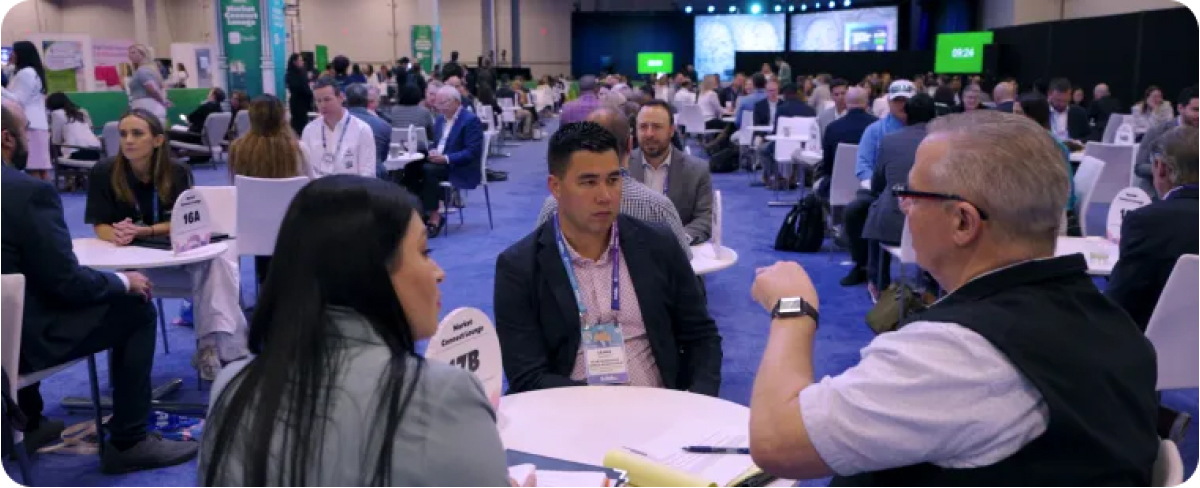
Pre-event leads reset the window
40% of exhibitor leads are created before the event begins, according to the same first-party report. That finding changes the measurement window. A report that starts at onsite check-in omits a large share of recorded buyer activity before the first badge reaches the expo floor.
Calculate pre-event lead share by dividing the number of unique leads created before opening day by the total number of unique leads created during the full reporting window. Keep the opening date and final cutoff constant across editions. If one report includes four pre-event weeks and another includes only seven days, the comparison measures window length rather than performance.
Pre-event share also shows whether sponsor inventory creates early demand. Exhibitor profiles, meeting requests, and saved items all indicate whether buyers arrive with a plan. An association conference with a low pre-event share has an activation issue that warrants investigation before changing booth packages.
Combined capture expands the baseline
Combining digital engagement and lead capture produces 83% more leads, according to the State of Event Engagement Report Volume 2. The figure does not mean every additional lead carries equal value. It shows that badge-only measurement leaves a substantial part of the available demand record outside the baseline.
A fair comparison requires deduplication. One attendee who views a profile, books a meeting, and later scans at the booth should remain one lead with several signals, not three leads. Without that rule, expanded source coverage inflates volume and weakens trust.
The better record resembles a session attendance history rather than a turnstile count. A turnstile proves entry once. A history shows what the attendee selected, revisited, and acted on, giving exhibitors the context needed for a relevant follow-up.
Qualification makes volume comparable
Qualification makes the exhibitor lead volume comparable only when teams fix the criteria, threshold, and denominator before the first lead is scored. The model needs declared fit criteria, observable intent, a fixed score threshold, and a stable denominator. Without those rules, one exhibitor's "qualified lead" can mean another exhibitor's unreviewed scan.
Fit and intent define quality
Fit describes whether the attendee matches the exhibitor's target market. Intent describes whether the attendee took an action associated with interest. Strong event lead qualification keeps those two dimensions separate because a well-matched attendee may show no intent, whereas an active attendee may fall outside the target account profile.
Organizers should agree on the criteria before registration opens. A practical model can use:
- Fit fields such as role, organization type, geography, or purchasing responsibility
- Intent signals such as a meeting request, repeat profile visit, saved product, or qualification response
- A published threshold that identifies which combinations count as qualified
Lead scoring has a real limitation. A shared model improves comparison, but exhibitors with different sales cycles will not value every signal equally. Organizers can allow custom weighting while keeping the reported qualification rule visible.
Denominators keep rates honest
The qualification rate should normally use all unique captured contacts as its denominator. Dividing qualified leads only by scored leads can hide low-scoring coverage.
Consider two hypothetical exhibitors at the same annual meeting. Exhibitor A scores 20 of its 200 captured contacts and reports a 40% qualification rate using scored leads as the denominator. Exhibitor B scores all 200 contacts and reports a 15% qualification rate using total captured leads. Exhibitor A's rate looks stronger, but Exhibitor B's scorecard is more transparent. Without knowing both the denominator and the scoring coverage, those numbers cannot be compared or used in a renewal report.
Track scoring coverage beside the qualification rate when not every contact receives a score. The calculations are straightforward:
- Qualification rate equals qualified unique leads divided by all unique captured leads
- Scoring coverage equals scored unique leads divided by all unique captured leads
- Meeting conversion equals completed meetings divided by accepted meetings
If teams prefer qualified leads divided by scored leads, label the denominator clearly and report scoring coverage beside it. The calculation is valid, but it answers a narrower question.
Expo! Expo! shows scoring potential
The IAEE Expo! Expo! case study provides association-specific evidence that lead quality can be reported alongside engagement. At the event, 60% of leads received a quality score of five out of five. The case study also recorded 893 meetings planned in advance, connecting pre-event activity with measurable exhibitor outcomes.
One association event does not establish an association-wide qualification benchmark. The IAEE Expo! Expo! results show what structured scoring can surface, not what every annual meeting should achieve. Event mix, scoring rules, attendee profile quality, and exhibitor participation all affect the rate.
An event participant summarized the value in practical terms: "So any time that you can provide a product or service to your attendees to make that happen, it's well worth the investment."
Revenue teams still need to translate that positive experience into a repeatable scorecard. Teams comparing source coverage, scoring rules, and meeting outcomes with their current reporting process can review Swapcard's lead capture and qualification capabilities.
Fast follow-up preserves intent
Follow-up performance determines whether captured intent reaches an exhibitor's sales process. Lead access, assigned ownership, customer relationship management (CRM) handoff, and time to first action belong in revenue reporting because a qualified lead loses commercial value when nobody receives or acts on it.
Access delay erodes intent
Only 3% of exhibitors download their leads within 90 days, according to the State of Event Engagement Report Volume 2. The finding exposes an action gap, although it does not reveal whether leads reached exhibitors through another route.
Measure the time to lead access from lead creation to the moment the exhibitor can retrieve or receive the record. Use the median rather than the average, since a few very late files can distort the average. Report the 90th percentile as well when delayed cases affect top-tier sponsors.
A lead report that sits untouched for weeks cannot support timely outreach. Organizers may have completed the technical delivery, yet the exhibitor still lacks commercial access if nobody knows where to find the data.
Ownership starts the action clock
Access and action are different measures. The organizer controls when the lead becomes available, while the exhibitor controls assignment and outreach. Renewal reporting should show both, so each team can see where the delay occurred.
Set three timestamps for every lead workflow: available to exhibitor, assigned to an owner, and first action recorded. The CRM handoff should preserve the lead source and qualification context rather than transferring only a name and email address. When those fields disappear, sales teams cannot distinguish a booth scan from a high-intent meeting request.
If a lead has no owner, the action clock has no accountable endpoint. Assigning ownership before the event closes gives exhibitors a clearer path from attendee engagement data to follow-up.
Benchmarks need visible context
An exhibitor lead-capture benchmark with a missing source, event type, or denominator has limited decision-making value. Portfolio data can reveal broad patterns, while a single-event case study can show execution in context. Neither should be presented as neutral evidence when the source is first-party.
Source type changes meaning
The quantitative evidence in this article comes mainly from first-party event data and customer case studies. That evidence is valuable because it records real platform behavior across events. It also carries limits: platform adoption, customer mix, feature use, and reporting definitions shape the observed numbers.
Qualitative customer statements add context without creating a benchmark. The IAAPA case study explained the need for digital reach in direct terms: "Because we're a global organization, we actually needed to be able to have a touchpoint with all of these individuals, and having Swapcard was a really great way to do that." The quote supports the importance of digital reach, but it does not establish a target digital lead share.
Neutral, association-wide research on qualification rates remains limited. Revenue teams should not fill that gap by relabeling vendor commentary as independent evidence. A local baseline across consecutive editions is more defensible than an unsupported market average.
Context prevents false comparisons
Before adding any exhibitor lead capture figure to a revenue plan, record five details: source owner, event type, event size, capture window, and denominator. A benchmark without these details has limited decision value.
A 60% top-score rate from a single association event cannot be directly compared with an 85% digital lead share from a portfolio report. One measures quality within a scoring model. The other measures the source mix. Placing them on the same chart without definitions creates a false performance story.
Use externally looking benchmarks for orientation, then baseline the association's own event. First-party event data becomes more useful when the same rules remain in place for the next edition.
Renewal evidence shapes commercial decisions
Renewal reporting should connect lead source, qualification, ownership, and action to the sponsor package that produced them. A five-metric scorecard gives association revenue teams a stable baseline, while meeting outcomes and package-level evidence support pricing decisions without relying on badge-scan volume alone.
Reports connect the source to the action
An exhibitor's report should show what the package delivered and what the exhibitor did with it. Lead quantity remains useful, but it belongs beside qualified lead rate, completed meetings, access timing, and follow-up status. Those measures turn exhibitor ROI metrics into a chain of evidence.
Keep the report close to the operational record. For each sponsor, show the source of each lead, the applied quality rule, the assigned owner, and the recorded action. Exhibitor ROI reporting becomes more credible when every summary number can be traced back to the four-field lead record.
Five metrics create the baseline
Build the first scorecard from one completed event, then preserve the same definitions for the next edition. The goal is not to copy a market target. It is to create a defensible comparison that reveals whether source coverage, quality, and follow-up improved.
Record scoring coverage beside the qualification rate when some leads remain unscored. Track completed meetings separately so that meeting conversion does not get buried in the general lead total. Small definitions prevent large arguments during renewal discussions.
Evidence supports tiers and pricing
Commercial packaging improves when each tier promises evidence that the association can actually report. A premium lead package can be assessed through qualified lead rate and access speed. A meeting package can be assessed through accepted and completed meetings. A visibility package needs digital interaction data tied to identifiable lead sources.
If a package produces high volume but low qualification, the offer needs tighter targeting or clearer expectations. If qualified demand appears but access is slow, the handoff needs attention before the next sale. If renewal evidence coverage is incomplete, pricing discussions will again rely on anecdotes.
Association teams reviewing whether their current reporting can support those package decisions should start by mapping the five metrics against their current lead workflow. Teams ready to connect that workflow to one reporting record can get started with Swapcard.
Badge scans still matter. They simply cannot carry the full renewal case. Baseline the five metrics, hold the definitions steady, compare the next edition, and direct measurement investment toward the sponsor packages with the weakest evidence.
FAQs
How do I improve lead follow-up after an event?
To enhance lead follow-up, first assign a dedicated team member to manage outreach immediately after the event. This person should review and qualify leads while conversations are fresh. Implement a structured follow-up process, ensuring that leads are categorized based on their engagement level. Additionally, utilize tools like Swapcard's Exhibitor Lead Center to streamline lead management, allowing for quick access to lead data and context, which can facilitate timely and personalized outreach.
What if I want to capture leads before the event starts?
To capture leads before the event, activate your event platform at least six weeks in advance. This allows attendees to engage with your content, request meetings, and bookmark exhibitors early on. Promote pre-event activities through targeted email campaigns and social media to generate interest. Using Swapcard's features, you can track digital interactions that occur before the event, which can significantly contribute to the overall lead volume.
Can I measure the quality of leads captured at my event?
Yes, measuring lead quality involves implementing qualification criteria that assess fit and intent. Use a scoring system to evaluate leads based on their engagement during the event, such as meeting requests or profile visits. This can be facilitated through Swapcard's lead capture tools, which allow you to annotate leads and assign scores based on predefined criteria, helping you identify which leads are most likely to convert.
When should I start promoting my event to maximize attendance?
Start promoting your event as early as possible, ideally six weeks before the event date. This gives potential attendees ample time to register and plan their participation. Utilize various channels, such as email marketing, social media, and partnerships with industry influencers, to reach a broader audience. Engaging attendees early not only boosts registration numbers but also allows you to gather valuable data on their interests, which can enhance matchmaking capabilities during the event.

Bhavya Sharma
Senior Content Marketing Manager
Bhavya leads content strategy across the funnel at Swapcard, pairing flagship research with storytelling that turns awareness into pipeline.





Join 12,000 subscribers and unlock industry secrets.
By submitting this form, you agree to receive periodic emails on insightful content related to events and our product, and in accordance with our Privacy Policy. You can, of course, change your preferences or unsubscribe at any time.