How to generate trade show leads: Step-by-step for exhibitors

A badge scan captures a name, an email address, and little else. Association exhibitors can leave a busy trade show with hundreds of contacts and still lack the context their sales teams need. Strong trade show leads come from a repeatable process that starts before arrival and continues after the booth closes.
Association sponsorship teams set the standard for that process. Give every exhibitor documented target criteria, clear booth roles, shared qualification criteria, mandatory data fields, assigned follow-up owners, and proof points for renewal. That operating plan turns lead generation into evidence that exhibitors can use.
Key takeaways:
- A badge scan records contact data, not buying intent
- Pre-booked meetings give booth teams a stronger context than walk-up traffic alone
- A shared qualification script keeps lead routing consistent across booth staff
- Customer relationship management (CRM) field mapping and ownership must be settled before opening
- A segmented follow-up cadence keeps qualified leads from sitting untouched
Badge scans do not prove intent
Badge scans identify who visited a booth, but they do not explain why the person stopped or what should happen next. Exhibitors need qualification details, buyer intent signals, and clear ownership before a contact becomes useful sales information. Scan volume alone cannot defend exhibitor return on investment (ROI). Yet most exhibitor renewal conversations still start with attendance numbers and badge totals — a weak foundation for a commercial argument.
Separate contacts from qualified leads
A contact record usually contains a name, title, company, and email address. A qualified lead adds business need, role in the decision, expected timing, product interest, and an agreed next step. Without those details, sales teams receive a list that requires another round of discovery after the trade show.
Badge scanning still matters. It captures contact details quickly during peak traffic and reduces manual data entry. The limitation is equally clear: lead capture without qualification prioritizes volume over usable sales context, leaving booth teams with impressive activity reports and little evidence of renewals.
Association teams can test their current process with three questions. Does every scan include a lead class? Can sales see what the attendee discussed or viewed? Does every qualified record have an owner? A "no" to any of them reveals exactly where the lead workflow breaks, and it usually breaks in the same place: no one decided who owns the record before the show opened.
The standard is simple. Capture identity quickly, then add enough context to guide the sales handoff. Association teams building that discipline into exhibitor onboarding can use the exhibitor lead capture strategies as a starting point for qualification criteria and field requirements.
Why does your sales team keep saying the show leads aren't worth following up on
Sales teams ignore show leads for a predictable reason: the contact arrived without enough context to act on. Pre-show targeting solves that by giving booth staff documented target criteria before traffic begins. The work starts by matching each exhibitor's goal with the attendee companies and roles most likely to support it. Broad outreach produces more names, while focused outreach creates stronger meeting context and more useful trade show leads.
Define the target account profile
Exhibitors often enter an association trade show with different goals. One exhibitor wants a smaller group of qualified buyers, another wants broad product visibility, and another wants scheduled demonstrations. Effective exhibitor programs align lead activity with those goals rather than applying one target list to every booth.
Start with the exhibitor goal, then group target accounts by fit and current need. Company type, buying role, stated interests, and prior engagement can narrow the list. The association team should ask exhibitors to identify which factors are required and which merely improve fit.
A usable profile can be documented in four parts:
- Account fit based on company type, size, market, or member segment
- Buyer role based on influence, authority, or direct use
- Current need based on stated interests or known business priorities
- Desired action, such as a meeting, demonstration, or sales follow-up
The profile does not need to exclude every imperfect fit. Broad awareness still has value for exhibitors pursuing visibility. Yet a lead-generation package needs a tighter standard, because sales capacity should not be spent evenly across every attendee record.
Book buyer conversations before arrival
Waiting for the expo hall to open misses a large part of the buying journey. According to the State of Event Engagement Report, Volume 2, 60–65% of networking happens before the event, and 40% of exhibitor leads are created pre-event. Pre-booked meetings give booth staff far more context than walk-up traffic alone.
Meeting preparation should connect the target profile to a named conversation. Exhibitors can review the buyer's role, stated interests, saved content, and requested topic before arrival. Booth staff then begin with a relevant business issue instead of a general opening question.
Pre-booked meetings should not consume every available slot. Walk-up conversations remain valuable, especially when attendees' needs become clear onsite. Reserve scheduled blocks for high-fit accounts and leave defined periods for discovery traffic, demonstrations, and referrals.
A pre-show meeting plan should confirm:
- Target buyer and account
- Meeting purpose
- Assigned booth representative
- Relevant product or service
- Qualification questions
The exhibitor arrives with a working agenda, not a blank calendar. That preparation sets the booth team up to consistently convert conversations.

Booth teams convert conversations
Booth conversion depends on staff roles and a short conversation flow, not maximum scan volume. Every attendee should meet the right representative, answer the same core qualification questions, and leave with a clear next step. A busy booth without those controls produces uneven records and missed handoffs.
Assign booth roles and flow
Treat the booth like a well-run session room. One person welcomes attendees, another keeps each discussion focused, and a third records the outcome before the next visitor arrives. Without defined roles, peak traffic becomes a crowded doorway where contacts enter faster than staff can qualify them.
Smaller booths do not need a different person for every role. One representative can open and qualify while another handles technical questions and records the next steps. The deciding factor is clarity: every team member must know when to continue a conversation, when to hand it over, and who owns the record afterward.
Assign four responsibilities before doors open:
- Opener identifies the reason for the visit
- Qualifier asks the shared high-signal questions
- Recorder captures notes, lead score, and source
- Next-step owner confirms the meeting or follow-up action
During peak traffic, use a visible handoff cue or a shared status in the lead record. If a technical discussion requires a specialist, the opener should record the original need before transferring the attendee. Context should move with the person.
Ask short high-signal questions
Four focused questions usually provide more usable context than a long booth form. Ask about the current need, the attendee's role, the expected timing, and the preferred next step. Each answer should map to a defined lead score or routing rule.
Detailed qualification forms have a valid place in longer hosted buyer meetings. They are less suitable for a short walk-up conversation where a queue is forming. A short form leaves some nuance uncaptured, but booth notes and a scheduled follow-up can add that detail without slowing every interaction.
Keep the shared qualification script direct:
- What brought the attendee to the booth?
- What problem or project are they working on?
- What role do they play in the decision?
- What timing applies?
- What should happen next?
Translate answers into a small number of lead classes. A high-priority lead has a clear need, a relevant role, defined timing, and agreed action. A nurture lead has fit but no current project. A contact without a stated need remains in the awareness segment rather than entering the same sales queue as qualified trade show leads.
Capture channels build one lead record
A complete lead record combines onsite capture with digital behavior. It also protects context and prevents duplicates. Badge scans, profile views, bookmarks, messages, meetings, and session interactions each reveal a different aspect of intent, and the record becomes useful only when those signals are tied to one person and one company.
Combine every capture channel
Most event leads come from digital interactions beyond onsite badge scans. The State of Event Engagement research places the share from digital touchpoints between 67% and 85%, depending on the event segment. Organizers should treat that range as directional first-party evidence, not a promised association benchmark.
Digital activity does not automatically equal buying intent. One profile view carries less weight than a confirmed meeting or repeated product engagement. Lead scoring should reflect that difference and preserve the source of each action rather than adding every interaction into one undifferentiated total.
A balanced trade show lead-capture plan can include badge scanning, meeting activity, exhibitor bookmarks, and engagement with relevant sessions. For associations whose members are distributed across regions and segments, digital capture fills the gap left by booth traffic alone. At GITEX, exhibitors used the same platform for digital matching and onsite scanning, setting up 4,508 meetings across concurrent events — a reach that booth traffic alone could not create.
Build one complete lead record
One lead record needs a stable matching key across every capture channel. An email address usually provides that key, supported by the attendee ID and the company ID, where available. If badge data, meeting data, and digital behavior use different identifiers, duplicates will appear before sales receives the file.
Define required data in five groups: contact information, qualification, and consent, with source and intent recorded for each interaction. Then set accepted values for fields such as lead class, product interest, timing, and next step. Free-text notes should add detail, not replace structured fields needed for routing and reporting.
The minimum record should include:
- Full name, title, company, and email address
- Attendee and company identifiers
- Capture source and timestamp
- Relevant digital interactions
- Qualification answers and lead score
- Consent status
- Assigned owner
- Agreed next step
Missing-data rules matter as much as required fields. If a record lacks consent, hold it from outreach until the correct rule is applied. If two records share an email address, merge activity while preserving source history. If the email differs but the company and attendee IDs match, route the record to review.
Treat scale-proof with care
Large trade shows show what structured capture looks like at volume, but their results are not automatic benchmarks for association events. The HLTH 2025 case study recorded 29,873 exhibitor leads, an 18% year-over-year increase, alongside 91% active usage. HLTH reached those numbers by combining structured networking, exhibitor training, lead capture, and digital participation into one program.
The figures show that high participation can create a richer lead pool. They do not isolate the conversion effect of a single tactic, nor should an association use them to forecast. The practical lesson is narrower: scale requires joint activity data, consistent exhibitor training, and a single record for each attendee.
Joined records still need a destination. CRM specifications and sales ownership must be ready before the first attendee enters the hall.
CRM handoffs begin before opening
CRM handoffs work when field mapping, consent, ownership, and sync timing are settled before exhibitors capture their first lead. Waiting until the show closes exposes mismatched values, duplicate records, and unowned contacts. A sample record should complete the full route before onsite activity begins.
Map every required CRM field
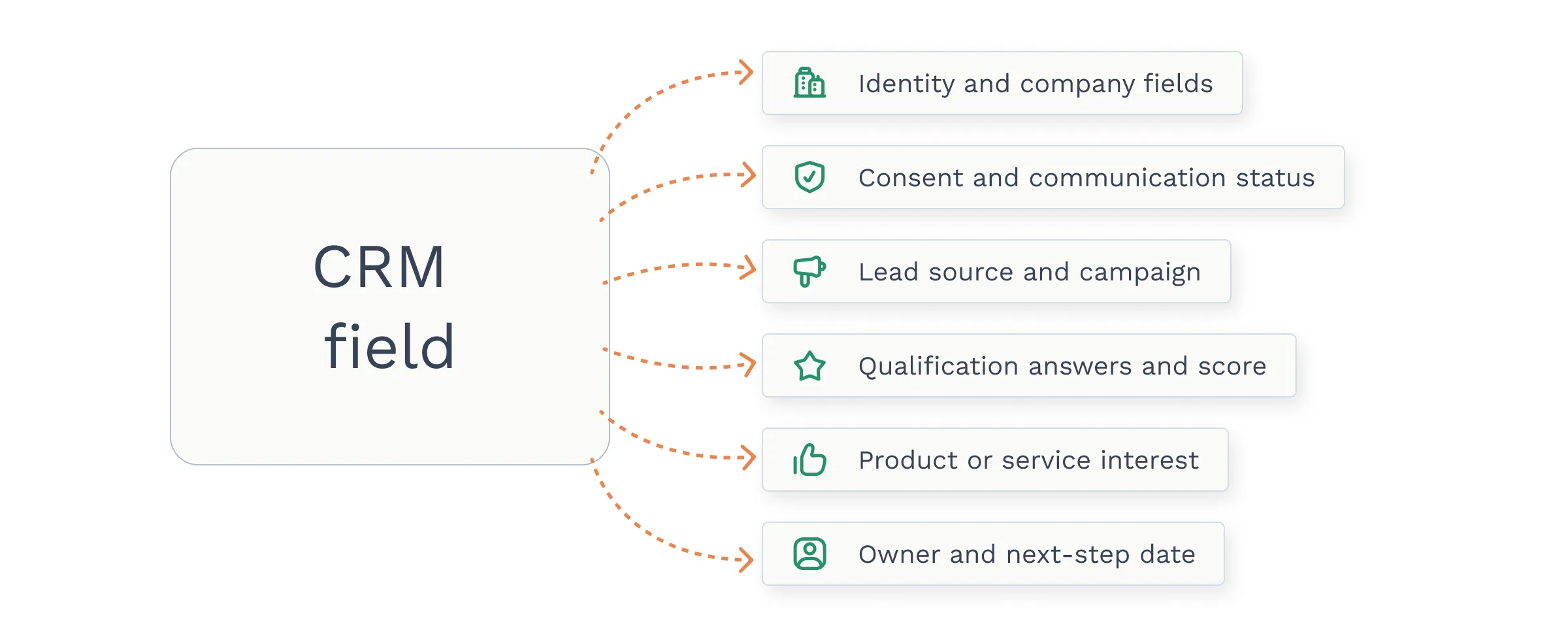
CRM field mapping should begin with a shared data dictionary. List every source field, destination field, accepted value, required format, and owner. Mapping breaks in predictable places. "Job level" cannot map reliably if the capture tool records "Director" while the CRM accepts only coded values such as senior leader or manager.
Run a sample trade show lead through the entire path at least once before opening. Capture it, qualify it, sync it, and confirm that the correct owner receives it with notes and source data intact. Repeat the test for each lead class.
Check the mapping in this order:
- Identity and company fields
- Consent and communication status
- Lead source and campaign
- Qualification answers and score
- Product or service interest
- Owner and next-step date
A spreadsheet export remains a workable fallback for exhibitors with low lead volume or no direct CRM connection. That option requires the same field dictionary. Otherwise, the manual file simply moves the mismatch downstream.
Name owners and sync timing
Every lead segment needs a named owner before the show. High-priority trade show leads may route to an account executive. Nurture leads move to marketing automation, and existing customers return to account management. A shared inbox does not count as ownership.
Set the sync timing and follow-up service-level agreement (SLA) together. If sales must respond within 48 hours, records cannot sit in an export queue for three days. Event teams should also define an exception queue for rejected records, missing mandatory fields, duplicate matches, or unavailable CRM owners.
A pre-opening test should confirm four points:
- The record arrives within the agreed sync window
- The assigned owner receives a notification
- Qualification notes remain readable
- Rejected records enter a visible exception queue
Technical integration alone does not complete the handoff. Sales managers must accept the routing rules and reserve the capacity to act on them.
Follow-up protects exhibitor renewals
Follow-up protects renewals when qualified records reach named sales owners within 48 hours, and reporting connects activity to exhibitor goals. Speed matters, but relevance matters more. Associations should measure accepted handoffs and completed next steps, not email volume alone.
Start segmented follow-up within 48 hours
Segment the first outreach by lead score, stated need, and agreed next step. A buyer who requested pricing should not receive the same message as an attendee who bookmarked a profile.
Sales capacity creates a real constraint. Sending every contact to the same team within 48 hours often produces rushed, generic outreach. Route high-priority records first, assign nurture contacts to a scheduled sequence, and suppress records that lack consent or a clear reason for contact.
Use a practical cadence:
- Within 24 hours, send the promised material or meeting confirmation
- Within 48 hours, make the first personalized sales contact
- Within five business days, attempt the agreed next action
- After the first week, move inactive records into the appropriate nurture segment
Platforms that centralize lead records and connect directly to a CRM can make that cadence easier to enforce.
Report outcomes against exhibitor goals
Renewal reports should compare lead outcomes with the goal agreed upon before the trade show. For a lead-quality exhibitor, report qualified records, accepted sales handoffs, and completed follow-up. For a meeting package, report on meetings booked and held. Visibility packages require different measures, such as profile activity and attributable interactions.
Joined data is what makes those reports credible. Informa Tech reported that integrating data across business units saved its team two weeks of work per event, and connecting registration, meetings, and lead activity turns raw totals into a renewal argument that holds up in a budget review.
Useful trade show ROI data should answer whether the exhibitor reached the intended audience and whether sales accepted the resulting records. Raw totals remain supporting evidence, not the renewal story.
Issue one operating checklist
One operating checklist keeps the association team, exhibitors, and sales owners working from the same specification. Issue it during exhibitor onboarding, review it in training, and audit it before the expo hall opens.
The checklist should confirm:
- Defined exhibitor goal and documented target criteria
- Pre-booked meeting plan
- Assigned booth roles and handoff cues
- Shared qualification questions and lead groups
- Required contact, intent, consent, and source fields
- Tested CRM mapping and sync timing
- Assigned follow-up owners for every lead segment
- Follow-up within 48 hours
- Proof points for renewal tied to the original goal
Audit the process at three points: before exhibitor training, during the final CRM test, and after the first show day. Those checks reveal whether organizer support, exhibitor readiness, or disconnected data is creating the gap.
Badge scans do not, by themselves, defend renewals. A repeatable pre-show, onsite, and post-show process does. Associations that standardize documented criteria, booth roles, shared qualifications, and clean CRM delivery give exhibitors a real shot at credible renewal evidence. That process requires a platform that connects pre-show targeting, booth capture, and CRM delivery without forcing teams to reconcile exports at every stage. Associations ready to run that connected process for capture, qualification, and reporting can get started with Swapcard.
FAQs
How do I capture qualified leads at a trade show?
To capture qualified leads at a trade show, start by defining your target profile before the event. This includes understanding the specific needs and roles of potential attendees. Next, pre-book meetings with these target accounts to ensure you have meaningful conversations. During the event, use a shared qualification script to ask consistent questions about their needs and interests. Finally, ensure that all leads are recorded in a centralized system like Swapcard's Exhibitor Lead Center for easy follow-up after the show.
What if I receive many badge scans but few qualified leads?
If you notice a high volume of badge scans but few qualified leads, it's essential to refine your lead qualification process. Focus on gathering more detailed information during the event, such as buyer intent and specific needs. Use short, high-signal questions to quickly assess the quality of each lead. Additionally, ensure that your booth staff is trained to engage effectively and capture meaningful conversations, rather than relying solely on scan volume.
When should I follow up with leads after a trade show?
You should follow up with leads within 48 hours after the trade show. Start with a personalized outreach to those who showed the most interest during your conversations. Use the information gathered during the event to tailor your messages, ensuring they address the specific needs discussed. This timely follow-up helps maintain engagement and increases the chances of converting leads into opportunities.
Can I use digital interactions to enhance lead capture?
Absolutely! Digital interactions such as booth bookmarks, in-app messages, and session engagements can provide valuable insights into attendee interests. Use these signals to enrich your lead profiles. For example, if an attendee bookmarks a specific product, make sure to reference that in your follow-up. This approach not only helps qualify leads more effectively but also personalizes your communication, making it more relevant to the potential buyer.
Why does pre-show targeting matter for exhibitors?
Pre-show targeting is crucial because it allows exhibitors to identify and reach out to the right audience before the event begins. By aligning exhibitor goals with potential attendees' interests, you can ensure your booth attracts qualified visitors. This proactive approach leads to more meaningful conversations and higher-quality leads, ultimately improving the ROI of your trade show participation.

Bhavya Sharma
Senior Content Marketing Manager
Bhavya leads content strategy across the funnel at Swapcard, pairing flagship research with storytelling that turns awareness into pipeline.





Join 12,000 subscribers and unlock industry secrets.
By submitting this form, you agree to receive periodic emails on insightful content related to events and our product, and in accordance with our Privacy Policy. You can, of course, change your preferences or unsubscribe at any time.